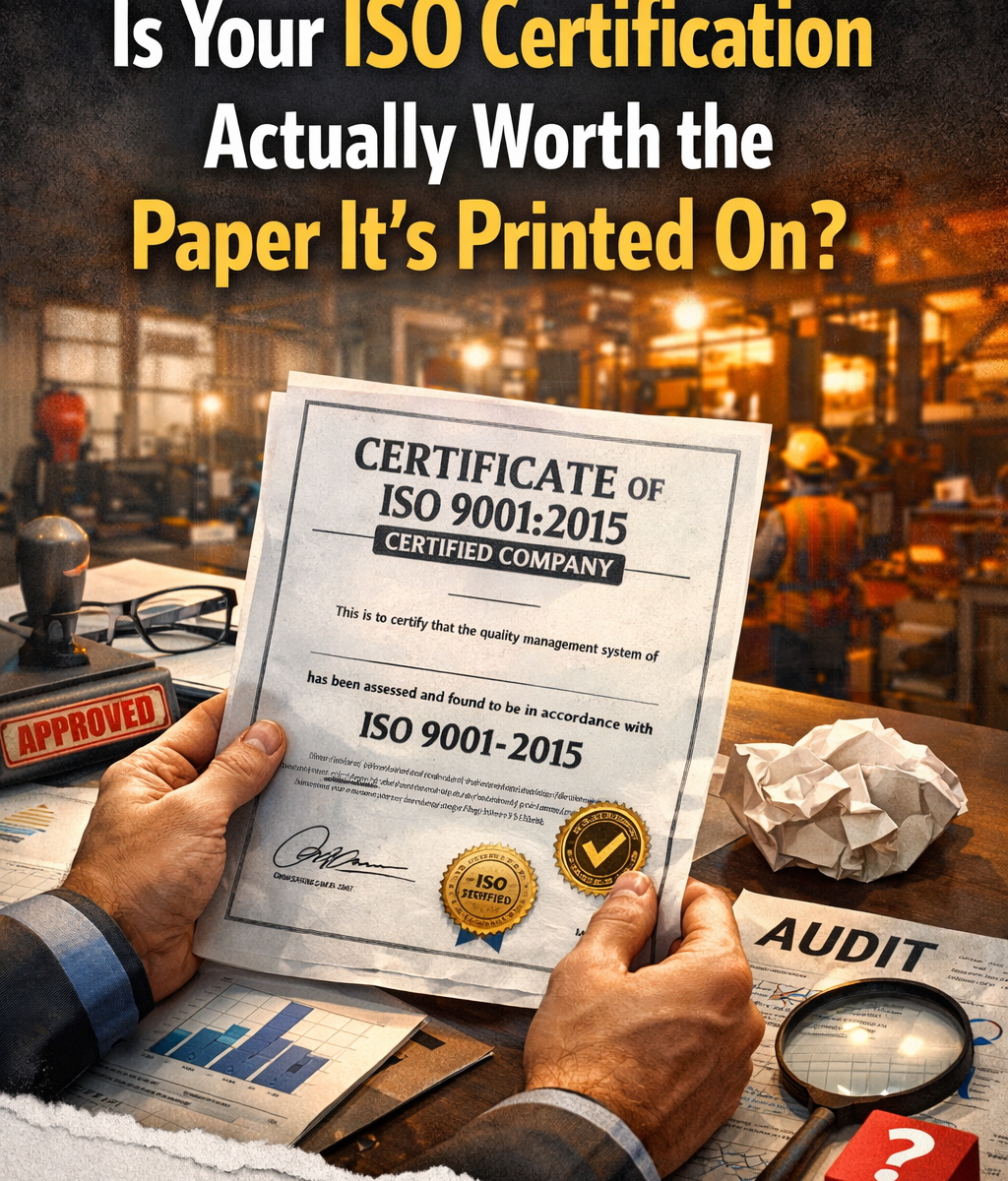
Is Your ISO Certification Actually Worth the Paper It’s Printed On?
Getting ISO certified is a significant milestone for any business. It signals to customers, partners, and regulators that your organisation takes quality, safety, or information security seriously. But here’s the thing that many businesses don’t realise until it’s too late: not all ISO certificates carry the same weight. In fact, some are worth considerably less than others, and choosing the wrong certification body could mean your hard-won certificate is dismissed outright by the very clients you were hoping to impress.
So before you sign on the dotted line with any certification body, it’s worth understanding the difference between UKAS-accredited and non-UKAS-accredited certification.
What Is UKAS?
UKAS, the United Kingdom Accreditation Service, is the sole national accreditation body for the UK, appointed by the government under European regulation (EA-2/17). Its role is to assess and accredit organisations that prov2de testing, inspection, and certification services. In plain terms, UKAS is the body that checks the checkers.
When a certification body holds UKAS accreditation, it means UKAS has independently verified that the certifier operates to internationally recognised standards, specifically ISO/IEC 17021, and that their auditors are competent, their processes are rigorous, and their certificates can be trusted.
The UKAS mark is internationally recognised through mutual recognition agreements with equivalent bodies in over 100 countries, including ANAB in the United States, DAkkS in Germany, and COFRAC in France.
UKAS-Accredited Certification: What It Means in Practice
When your business achieves ISO certification through a UKAS-accredited body, you receive a certificate that carries independent, government-backed assurance. This matters in several important ways.
Procurement and tendering. Many public sector contracts, NHS frameworks, and large corporate supply chain requirements specifically mandate UKAS-accredited ISO certification. Submitting a non-UKAS certificate in response to such requirements will often result in disqualification, no matter how impressive the certificate looks.
Client confidence. Sophisticated buyers know to look for the UKAS crown logo on ISO certificates. It tells them the certification wasn’t simply purchased; it was earned through a credible, independently overseen audit process.
Legal and regulatory recognition. In some regulated industries, only UKAS (or equivalent internationally recognised accreditation body) certification satisfies compliance requirements. A certificate from an unaccredited body simply won’t do.
Consistency and rigour. UKAS-accredited bodies are subject to regular peer assessment. Their auditors must demonstrate competence in the relevant sector. The audits themselves must meet defined criteria. There is accountability at every level.
Non-UKAS Certification Bodies: Buyer Beware
This is where things get uncomfortable, but it needs to be said plainly.
The ISO certification market is entirely unregulated in terms of who can set themselves up as a certification body. There is nothing legally preventing an organisation from calling itself a certification body, designing a logo that looks vaguely official, and issuing “ISO certificates” to paying clients. No government oversight. No independent competence checks. No accountability.
And that is precisely what some organisations do.
Non-UKAS certification bodies range from the merely informal (small operations that may conduct genuine audits but without the rigour or oversight that accreditation requires) to the frankly theatrical: operations that will issue you an ISO 9001 certificate following little more than a brief telephone consultation and the payment of a fee. The audit, if it exists at all, is perfunctory at best.
The resulting certificate might look convincing to an untrained eye. It might even use language that sounds authoritative. But it is, in essence, a piece of paper that has been bought rather than earned, and anyone who knows what to look for will see through it immediately.
These unaccredited schemes do a disservice to the entire ISO certification ecosystem. They undermine businesses that have genuinely invested in improving their processes, and they give clients a false sense of assurance about suppliers who may not have changed their practices at all.
How to Tell the Difference
Spotting the difference between accredited and unaccredited certification is straightforward once you know what to look for.
Look for the UKAS mark. Legitimate certificates issued by UKAS-accredited bodies will carry the UKAS crown logo alongside the certification body’s own mark. If you don’t see it, ask why.
Check the UKAS directory. UKAS publishes a searchable directory of all accredited certification bodies at ukas.com. If the body that issued your certificate, or a supplier’s certificate, isn’t listed there, it is not UKAS-accredited.
Ask about the audit process. A credible certification body will be happy to explain how their audits work, how long they take, and what qualifications their auditors hold. Vague or evasive answers are a red flag.
Be wary of unusually low prices and fast timescales. Achieving genuine ISO certification requires real work: a gap analysis, documented improvements, and a thorough audit. If a certification body is offering to have you certified within days or at a price that seems too good to be true, treat that with considerable scepticism.
The Business Case for Getting It Right
Achieving UKAS-accredited ISO certification costs more and takes longer than going with an unaccredited shortcut. That’s because you’re doing it properly. Your management systems are genuinely assessed. Your processes are tested against the standard. Your team has to evidence real compliance.
But the return on that investment is a certificate that actually opens doors: to public sector contracts, to international clients, to regulated supply chains. It will not be one that gets quietly set aside the moment a procurement manager checks the UKAS directory.
More importantly, you get the substance behind the certificate. Businesses that go through a proper ISO certification process typically do improve. They identify inefficiencies, clarify responsibilities, reduce errors, and build more robust systems. The certificate becomes a reflection of real change, not just a marketing asset.
Final Thoughts
ISO certification is worth pursuing. The standards themselves, whether ISO 9001 for quality management, ISO 27001 for information security, ISO 14001 for environmental management, or any of the others, represent genuinely useful frameworks for running a better business.
But the value of certification depends entirely on the credibility of the body that issued it. UKAS accreditation is the benchmark in the UK. It is the difference between a certificate that commands respect and one that invites scrutiny.
Do the work. Choose an accredited body. Earn the certificate properly. Your clients and your business will be better for it.
To check whether a certification body is UKAS-accredited, visit the UKAS directory at www.ukas.com.