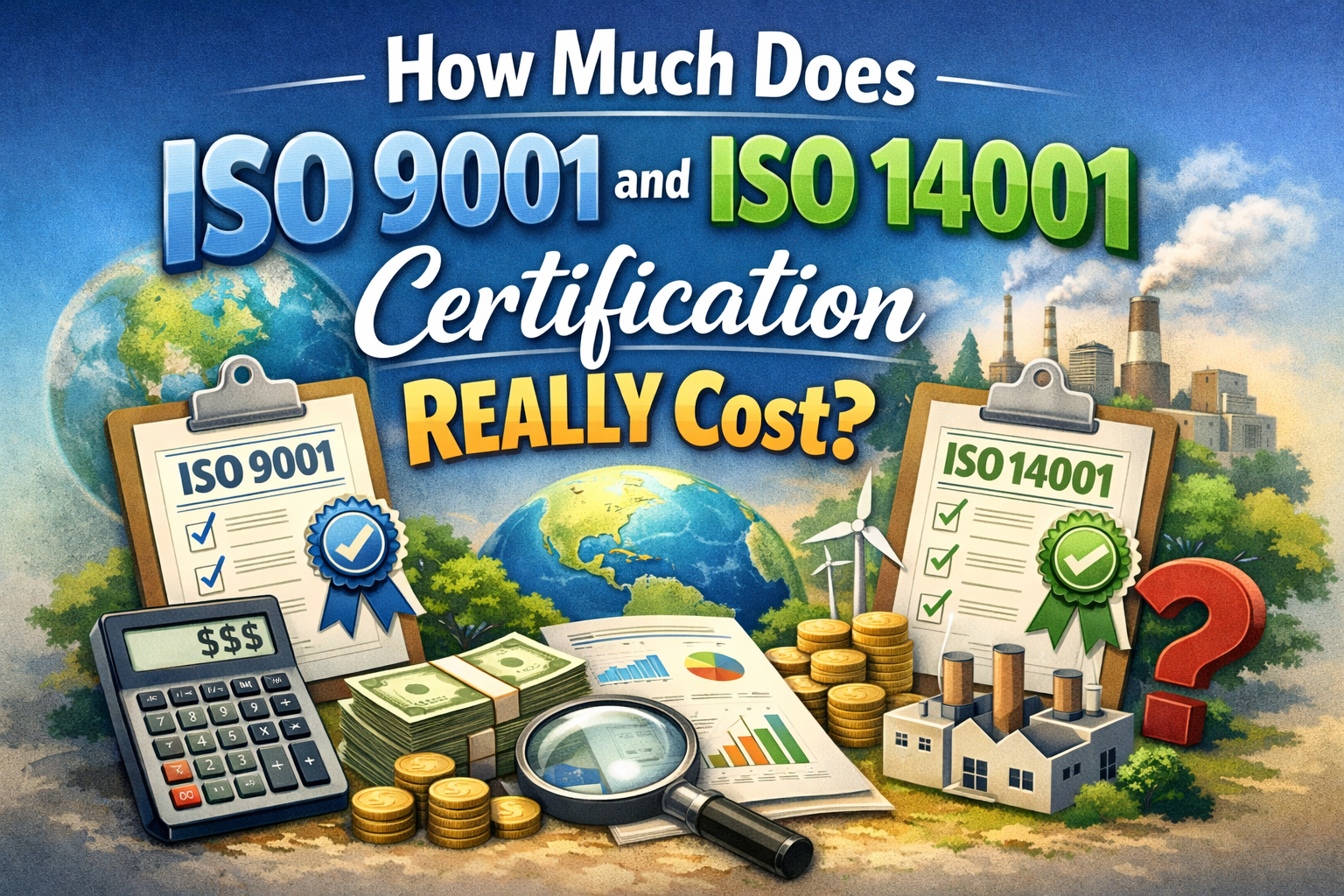
If you’re an SME considering ISO certification, one of the first questions you’ll ask is: what’s this going to cost us? It’s a fair question, and one that’s often met with frustratingly vague answers. The reality is that costs vary depending on the size of your business, the complexity of your operations, and the consultancy and certification body you work with , but there are solid benchmarks you can plan around.
Here’s a clear, honest breakdown of what to expect for both ISO 9001 (Quality Management) and ISO 14001 (Environmental Management).
ISO 9001: Quality Management System
ISO 9001 is the world’s most widely recognised quality management standard. For SMEs, it demonstrates to customers and stakeholders that your business operates to a consistent, auditable standard , and it’s often a prerequisite for winning larger contracts.
What Does Year One Look Like?
The first year is always the most significant investment. You’re building the system from scratch, documenting your processes, training your team, and going through the initial certification audit. When you factor in consultancy support from a firm like Accendo alongside the fees from a UKAS-accredited certification body, SMEs can typically expect to pay in the region of £6,000 to £7,000 all in for year one.
That figure covers the core elements you’d expect consultancy time to design and implement your management system, support through the gap analysis and internal audit process, and the external certification body fees for your Stage 1 and Stage 2 audits. UKAS accreditation matters here , it’s the UK’s national accreditation body, and certification from a UKAS-accredited body carries genuine weight with customers and procurement teams.
What About Ongoing Costs?
Once your system is established and certified, the annual costs drop considerably. Subsequent years , which involve surveillance audits and continued system maintenance , typically come in at around 40 to 50% less than year one. For most SMEs, that means ongoing costs in the region of £3,000 to £4,200 per year, depending on your business size and audit requirements.
This reduction reflects the fact that the heavy lifting is done. Your processes are documented, your team understands the system, and the external audit scope narrows to monitoring and continual improvement rather than building from the ground up.
ISO 14001: Environmental Management System
ISO 14001 sets out the requirements for an effective Environmental Management System (EMS). It helps businesses identify and control their environmental impact, meet legal obligations, and demonstrate their commitment to sustainability , something that’s increasingly important to customers, investors, and the supply chains of larger organisations.
Adding ISO 14001 to an Existing ISO 9001 System
Here’s where SMEs can make real efficiencies. If you already hold ISO 9001 certification, you don’t need to start from scratch with ISO 14001. The two standards share a common high-level structure (known as Annex SL), which means your existing management system framework , your document control, internal audit process, management review, and corrective action procedures , can all be leveraged and extended rather than rebuilt.
For businesses in this position, adding ISO 14001 into an existing ISO 9001 system is typically around £4,000 to £5,000 all in for year one. That includes consultancy support to develop the environmental aspects of your system , identifying your environmental aspects and impacts, setting objectives, building legal compliance registers, and preparing for the certification audit , alongside the certification body fees for the additional scope.
It’s a highly cost-effective way to achieve dual certification and send a clear signal to the market that your business takes both quality and environmental responsibility seriously.
Ongoing Costs for ISO 14001
Just as with ISO 9001, the annual costs for maintaining ISO 14001 certification reduce significantly after year one. Surveillance and recertification years tend to come in at around 40 to 50% less than the initial investment, making the combined ongoing cost of holding both standards very manageable for most SMEs.
The Bigger Picture: Is It Worth It?
Looking at the numbers, the investment for ISO 9001 in year one sits at around £6,000 to £7,000, dropping to roughly £3,000 to £4,200 in subsequent years. Adding ISO 14001 on top brings an additional £4,000 to £5,000 in year one, also reducing by 40 to 50% annually thereafter.
For many SMEs, ISO certification pays for itself relatively quickly. The benefits , winning contracts that require certified suppliers, improving operational efficiency, reducing waste and risk, and building genuine credibility with customers , often far outweigh the cost of getting and keeping the certificates.
If you’d like to understand exactly what certification would cost for your specific business, or you want to talk through what’s involved in the process, get in touch with the team at Accendo. We’ll give you a straight answer.
Accendo provides ISO consultancy and implementation support for SMEs across the UK. Our approach is practical, straightforward, and built around your business , not bureaucracy.