Author: Andrew Landels
If you write a clearer, evidence-based ISO internal audit report, you get better findings, sharper corrective action, and stronger ISO and HSEQ outcomes. That is not theory. For UK construction and contracting SMEs, the audit report is often the difference between a system that improves work and a system that only looks busy before surveillance.
A weak report hides the problem. A strong report makes the next step obvious.
Why does audit report quality matter more than the audit day itself?
Plenty of firms put effort into the walk-round. They sample jobs, talk to supervisors, and open the right folders. Then the write-up turns vague. Findings soften. Actions become wish lists.
Months later, the same issues reappear on site or in the next UKAS visit.
The report is the product of the audit. If it is unclear, the improvement cycle stalls. Clause 9.2 expects planned audits that check whether the system is working and whether you are conforming, plus results you can act on. Opinions without evidence do not meet that bar, even if the day felt thorough.
For construction SMEs, this shows up fast: snags that never close, method statements that do not match site practice, and H&S or environmental controls that look fine on paper and fail under pressure.
What does a weak ISO internal audit report look like?
You already know these patterns if you have sat through enough packs:
- Findings written as feelings (“communication could be better”) with no job, date, or clause.
- Evidence described as “discussed with site” and nothing you could re-check.
- Nonconformities and observations mixed so nobody knows what must change.
- Corrective actions with no owner, no date, and no link back to the finding.
- Pages of procedure paraphrase that never say what was sampled.
That style protects nobody. It does not help the supervisor, the MD, or a UKAS-accredited certification body. It just creates another document to store.
What does a better internal audit report include?
Open with the answer the reader needs, then prove it.
A practical ISO internal audit report for a construction SME usually covers:
- Scope and criteria: which processes, sites, or contracts you looked at, and against which parts of the system or standard.
- What you sampled: jobs, permits, inspection records, supplier checks, incidents, or waste tickets, matching the risk.
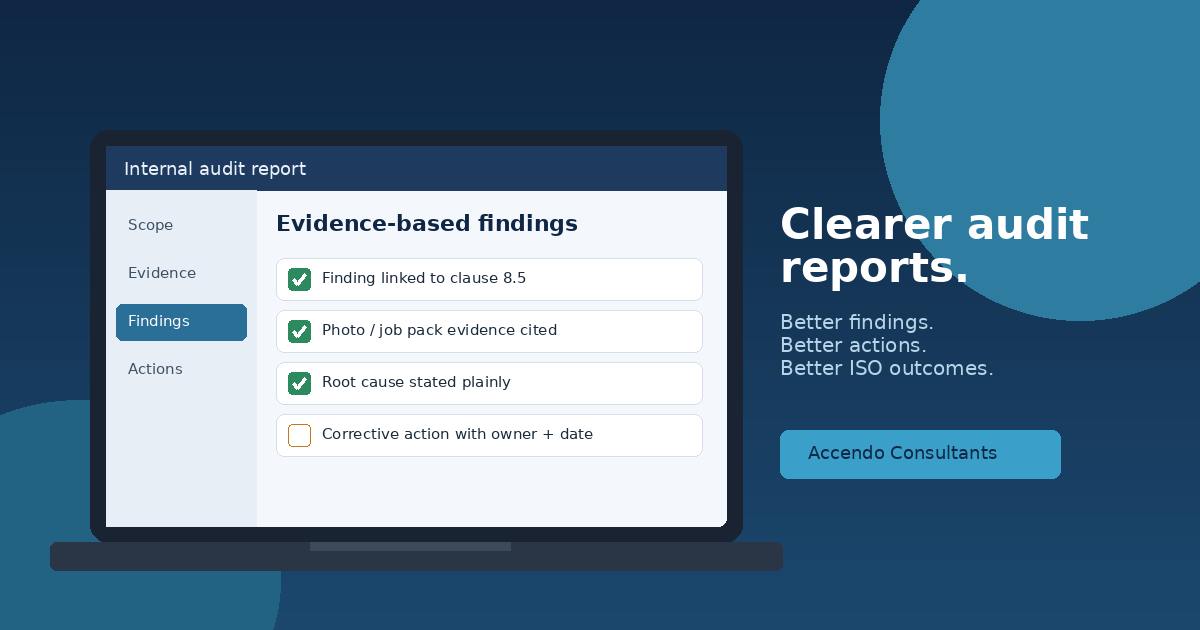
- Evidence-based findings: what you saw, where, and why it matters (conformity, observation, or nonconformity stated plainly).
- Risk and impact in business language: rework, delay, safety exposure, client complaint, tender risk, not only clause numbers.
- Corrective action that can close: owner, date, and a clear definition of done.
- Follow-up: how you will check the fix stuck, not only that a form was filled.
Keep paragraphs short. Name the site or job where it helps. Quote the requirement only when it clarifies the gap. You are writing for people who run work, not for a filing cabinet.
How do clearer findings drive better corrective action?
Corrective action fails when the finding is fuzzy. “Improve document control” can mean anything. “Two current job packs on Site X used superseded risk assessment RA-14 (rev C) instead of rev E issued on 3 March” can be fixed: replace the packs, brief the supervisors, check the next three jobs.
Clear findings also stop over-reaction. Not every gap needs a new procedure. Some need competence, a simpler form, or a conversation with a subcontractor. When the report states evidence and impact, leadership can choose a proportionate response, and HSEQ stays lean.
Better actions then feed management review with real data. You stop reporting “audit completed” and start reporting which issues closed, which recurred, and what that means for objectives and resources.
How does this help UKAS-credible certification and day-to-day HSEQ?
A UKAS-accredited certification body is looking for a living system. Internal audit that only exists in the fortnight before Stage 2 or surveillance is easy to spot. So is a report that cannot show sampling logic, evidence, or closed actions.
Stronger reports support UKAS-credible certification because they show checking, learning, and improvement. They also support the site gate: principal contractors, SSIP schemes, and clients care whether you fix problems, not whether you produced a long PDF.
If you run quality, environment, and health and safety as an integrated management system, one audit programme can look across shared processes. Integration does not excuse vague writing. It makes clear writing more valuable, because one report can drive action across HSEQ rather than three disconnected lists.
What should construction SMEs change this month?
You do not need new software to raise report quality. Try this on the next audit:
- Decide the sample before you arrive (contracts, high-risk activities, recent NCRs, new starters).
- Write findings the same day while evidence is fresh.
- Force every finding to answer: what, where, so what, and who owns the fix.
- Separate must-fix nonconformities from useful observations.
- Review open actions in the next toolbox talk or ops meeting, not only in the quality folder.
- Kill template wording that adds length without adding proof.
If your current templates push people into waffle, shorten the templates. The standard asks for effective auditing. It does not ask for a novel.
Where does Accendo fit?
Accendo Consultants works with owner-led construction and contracting SMEs across Scotland and the wider UK. We build systems people can run on live jobs, including internal audit that produces usable reports.
If you want that rhythm as part of a full integrated build, our Lean IMS option covers ISO 9001, ISO 14001 and ISO 45001 in one system, with audit and management review designed around how you already work. Accendo prepares the system. Certification stays with an independent UKAS-accredited body.
Write the audit better, and the output gets better. Better findings. Better corrective action. Better ISO and HSEQ outcomes on the jobs that pay the bills.
Accendo Consultants: lean ISO, UKAS-credible, built for how you work.