Before you sign an ISO deal sold “from a low monthly fee”, check two things: who accredits the certification body, and what the contract says about renewal and exit. Some large bundled providers sell ISO on multi-year contracts, and the certificate is not always UKAS ISO certification. For a construction or engineering SME, that can mean years of payments for a certificate a main contractor may not accept.
This is not a rant about competitors. Bundled packages suit some businesses. The point is simple: know what you are buying, and check it against what your clients ask for.
What is a bundled ISO package?
A bundled package wraps consultancy, software, templates and the certification audit into one monthly payment. That can look tidy. You get one supplier, one direct debit and a certificate at the end.
The catch is the term. One large provider’s own pricing example is based on a 7-year contract. Over that length of time your business can change a lot. You might win a framework, take on a new client with stricter supplier rules, or simply decide you want a different consultant. The contract does not change with you.
Is a non-UKAS certificate worthless?
No. A certificate from a body accredited by someone other than UKAS is not fake, and it is not automatically invalid. Accreditation is not a legal requirement for certification.
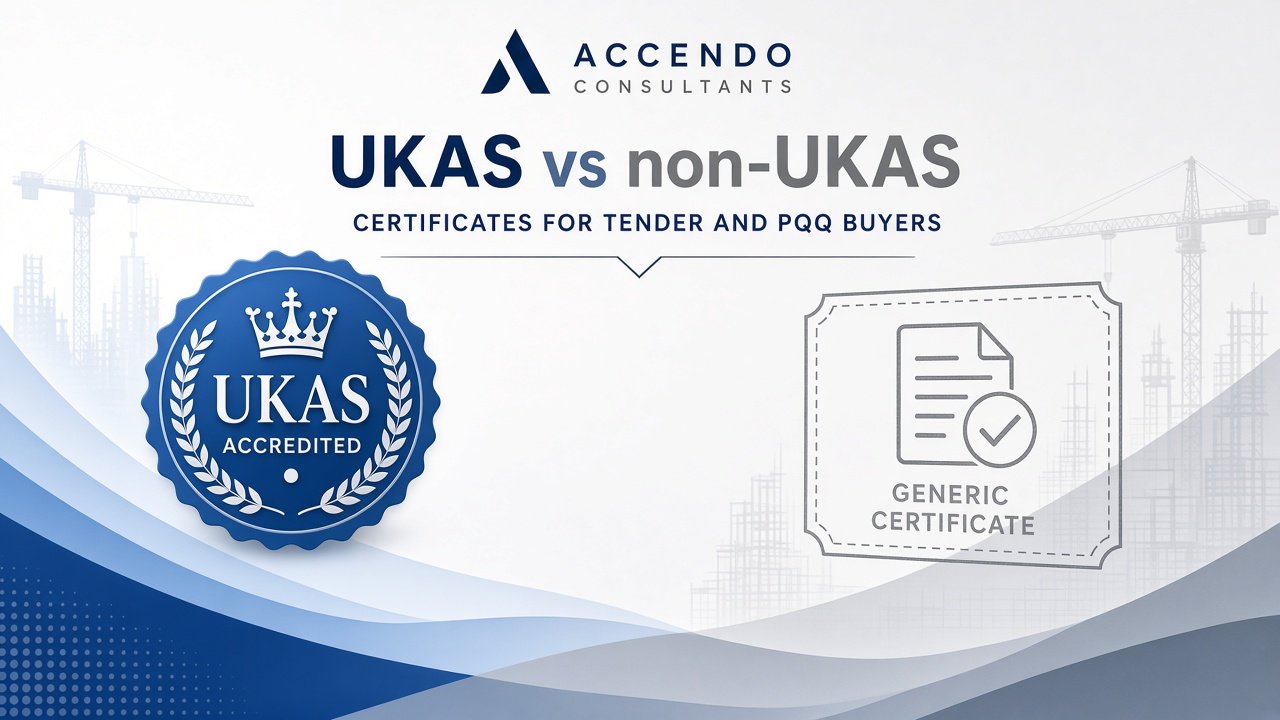
The real question is whether your buyers accept it. In the UK, UKAS is the national accreditation body appointed by government. Many main contractors, tenders and public buyers ask for certificates issued by a UKAS-accredited certification body, or by a body accredited through the international recognition arrangements that UKAS belongs to (these were run by IAF and are now run by Global ACI). Some buyers are relaxed about it. Others are not.
Some providers are open about this. One large provider’s certification arm says plainly on its own website that it is “not accredited by UKAS” and is accredited by a different, independent accreditation body. That accreditation body in turn says it is not a member of IAF, ILAC or Global ACI, and that whether a certificate is accepted for procurement “depends on the requirements set by the organisation, scheme or contracting authority involved”. In other words: it is up to your buyer.
Picture a groundworks contractor in West Lothian who signs a long contract, gets the certificate, then goes for a place on a main contractor’s supply chain. The pre-qualification form asks for UKAS-accredited ISO 9001. The certificate is real, but it does not tick the box. The business now needs a second certificate and is still paying for the first.
We cover the buyer side in more depth in UKAS vs non-UKAS certificates: what tender buyers actually check.
What do the renewal and exit terms look like?
Every contract is different, so read yours. But here is what one large provider’s published terms and conditions say, in plain English:
- Automatic renewal. Subscription contracts renew automatically for a further period equal to the initial term, unless either side gives written notice at least six months before the end of the term.
- Ending early by agreement. If both sides agree to end the contract early, you get a final invoice for 75% of the charges not yet invoiced for the rest of the contract period, plus VAT.
- Price rises. From the first anniversary, charges can rise once a year by the greater of 3% or the Retail Prices Index.
- Paying from day one. Charges for the ISO service start from the commencement date, whatever date the certificate is issued.
- Suspension. If audit issues are not put right in time, the certificate can be suspended, but you still pay the charges for the rest of the term.
None of that is hidden. It is in the document. The problem is that a busy contracts manager or MD often signs on the strength of the sales call and the monthly figure, not the small print.
How do I check a certificate and a certification body?
It takes a few minutes and costs nothing.
- Check the certification body. Search the UKAS directory of accredited organisations. If the body is UKAS-accredited for the standard you want (ISO 9001, ISO 14001 or ISO 45001), it will be listed.
- Check the certificate. UKAS CertCheck is a free tool for verifying UKAS-accredited management system certificates. IAF CertSearch covers certificates under the wider international arrangements.
- Ask the question directly. “Which accreditation body accredits your certification body, and for which standards?” A good provider will answer straight away, in writing.
What should I check before I sign?
Treat it like any other long-term commitment, such as a van lease or a plant hire agreement.
- Ask your main clients what they accept. Email your top three customers or check their supplier portals and pre-qualification questions. If they want UKAS, you have your answer.
- Read the renewal, notice and termination clauses. How long is the initial term? Does it roll over? How much notice do you need to give, and by when? What does it cost to leave early?
- Work out the total cost over the full term. Multiply the monthly fee by the number of months (a 7-year term is 84 payments), add any set-up fee, then allow for annual price rises. Compare that figure, not the monthly one.
- Check what you keep if you leave. Who owns the documents, procedures and records? Can you take your system to another consultant or certification body?
- Get it in writing. Anything the salesperson promised that matters to you should be in the contract. The terms we read say marketing materials do not form part of the contract.
How does Accendo do it differently?
As an ISO consultant UK businesses use mainly in construction, engineering and manufacturing, we keep consultancy and certification separate.
- We are not the certification body. We prepare you for audit by an independent UKAS-accredited certification body. Most of our clients are certified by NQA, with some using BSI or Intertek.
- Scoped fees, not a long subscription. Implementation is quoted for your organisation. Full Lean IMS for ISO 9001, 14001 and 45001 starts from £5,750 plus VAT. Retainers and other work are by enquiry.
- You deal with Andrew. Andrew Landels runs Accendo from Armadale, West Lothian, and works with clients directly.
- Lean, not heavy. A lean integrated management system that fits how your business already works, and that your own team can maintain.
If you are looking for an ISO 9001 consultant in Scotland or elsewhere in the UK, and you want a UKAS route you can explain to any buyer, we are happy to talk it through. If you have already been offered a bundled contract, send it over and we will tell you what to look for in it before you sign.
Contact us today at andrew@accendo.org.uk.
Accendo Consultants: lean ISO, UKAS-credible, built for how you work.