ISO competence is not a wall of colour-coded spreadsheets. For a construction or contracting SME in Scotland or elsewhere in the UK, ISO 9001 and ISO 45001 ask something simpler: people who affect quality and health and safety can do the work, and you can show how you know that.
If an ISO consultant has left you with five matrices nobody trusts, the problem is the design, not the standard.
What ISO competence actually requires
Clause 7.2 of ISO 9001 (and the matching competence requirement in ISO 45001) is about determining what competence you need, making sure people have it, and retaining appropriate documented information as evidence.
It does not demand:
- A separate matrix for every client portal
- Annual re-approval of skills everyone uses every week
- A novel for each toolbox talk
It does demand that you can answer, without panic: who is allowed to do this task, on what basis, and where is the current proof?
For construction that usually means trade tickets, CSCS or equivalent, plant cards, inductions, method-statement briefings, and any role-specific training your risk assessment or client rules require. Keep the list tied to real risk and real contracts, not to every imaginable course brochure.
Why competence admin balloons
The usual pattern on site businesses:
- Someone builds a giant matrix “for ISO”.
- Site managers keep a second list in WhatsApp or a notebook.
- HR or the office keeps certificates in email folders.
- Client portals get a third upload of the same PDFs.
- Before UKAS Stage 2 or surveillance, someone spends a week chasing expired cards.
That is not competence management. That is duplicate filing. It is also why owners conclude an HSEQ consultant construction engagement means hiring a full-time administrator. It does not, if the system is lean.
One source of truth beats five lists
A proportionate approach an ISO consultant UK buyers can defend in audit:
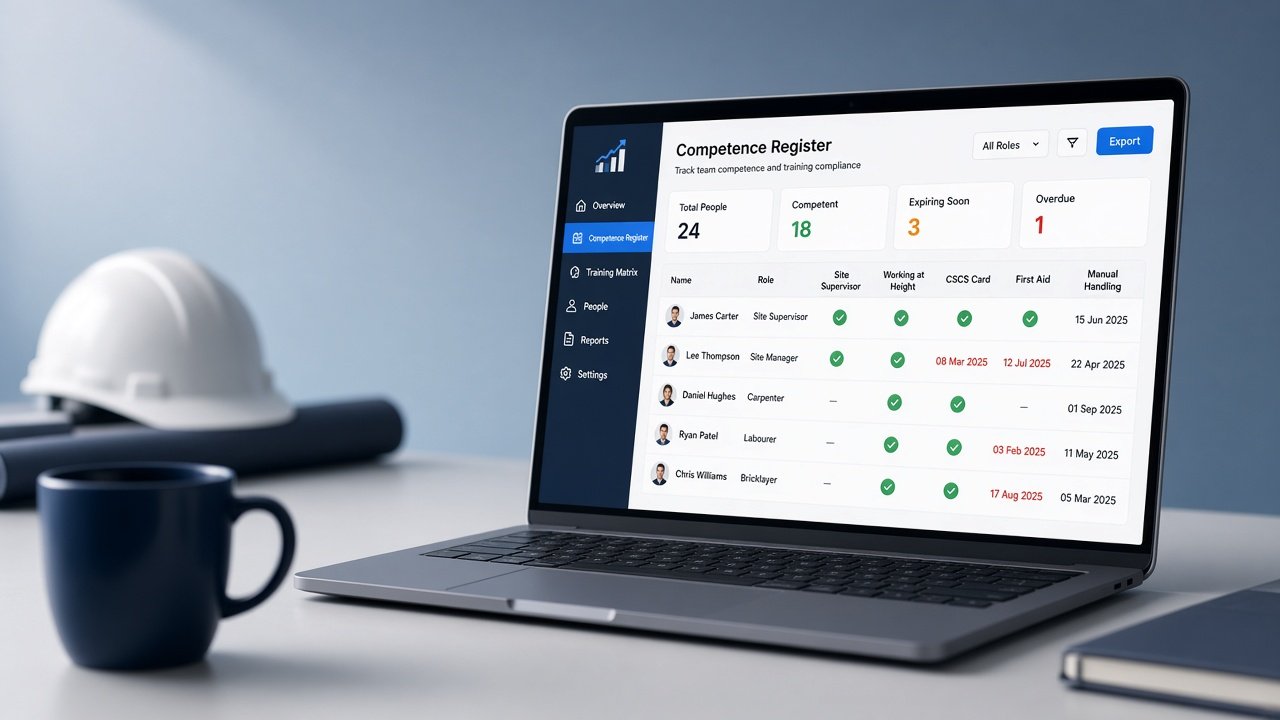
- One live register (or shared drive structure) as the master for people who affect the system
- Each person linked to the roles or tasks they actually do
- Evidence files that are the current certificate or induction record, not a photocopy of a photocopy
- Expiry or renewal dates where the ticket or course has a real end date
- Site access packs pulled from that same source, not rebuilt from scratch for every principal contractor
Document control for competence is version control: the right card, in the right place, obsolete copies removed. A matrix that is wrong is worse than a short list that is right.
Construction examples that usually matter
Prioritise what changes risk or blocks access:
- Plant and lifting tickets for the kit you actually use
- Asbestos awareness or licensed work where the work demands it
- Hot works, confined space, or working at height where your method statements say so
- First aid and fire marshal where your legal and site rules require cover
- Induction and briefing records for the job, not a generic corporate slideshow nobody remembers
Skip the decorative rows. If nobody on your sites ever needs a skill, do not invent a column for it “in case the auditor asks”. UKAS-accredited assessors prefer a short, accurate picture over a padded one.
Integrated management system, one competence spine
If you run quality, environment, and health and safety together, you do not need three competence systems for ISO 9001, ISO 14001, and ISO 45001. An integrated management system can share people records, training evidence, and awareness. Add environmental or H&S-specific competence only where the role genuinely needs it (for example waste carrier awareness for someone who books skips, or first aid for nominated people).
That is the same proportionate logic Accendo uses for construction SMEs chasing UKAS-credible certification without bureaucracy.
What UKAS assessors usually sample
Expect sampling, not a full HR audit of every employee since founding. Assessors often pick a few people on the organogram or on a live site, ask what they do, and ask for the evidence that supports that role. Gaps show up when:
- The matrix says trained, the person says they never were
- The certificate on file is expired and nobody noticed
- Agency or subcontractor people are treating your sites with no competence check at all
- Inductions exist as a blank template, never completed for the job in question
Close those loops and most competence nonconformities disappear.
Accendo’s take
Accendo Consultants helps construction and engineering SMEs in West Lothian, across the central belt, and UK-wide build lean ISO systems that match how the business already works. Competence should be a living access and risk control, not a spreadsheet hobby.
If your matrices disagree with each other, or with the people on site, that is the fix: one source of truth, risk-based rows, current evidence, and a clear owner. If you want an ISO 9001 consultant Scotland review of your competence and training trail before Stage 2 or surveillance, or a look at our Lean IMS option for ISO 9001, 14001 and 45001, get in touch via https://accendo.org.uk/.
Accendo Consultants: lean ISO, UKAS-credible, built for how you work.
https://accendo.org.uk/