ISO Competence Records for Construction SMEs (Without Spreadsheet Hell)

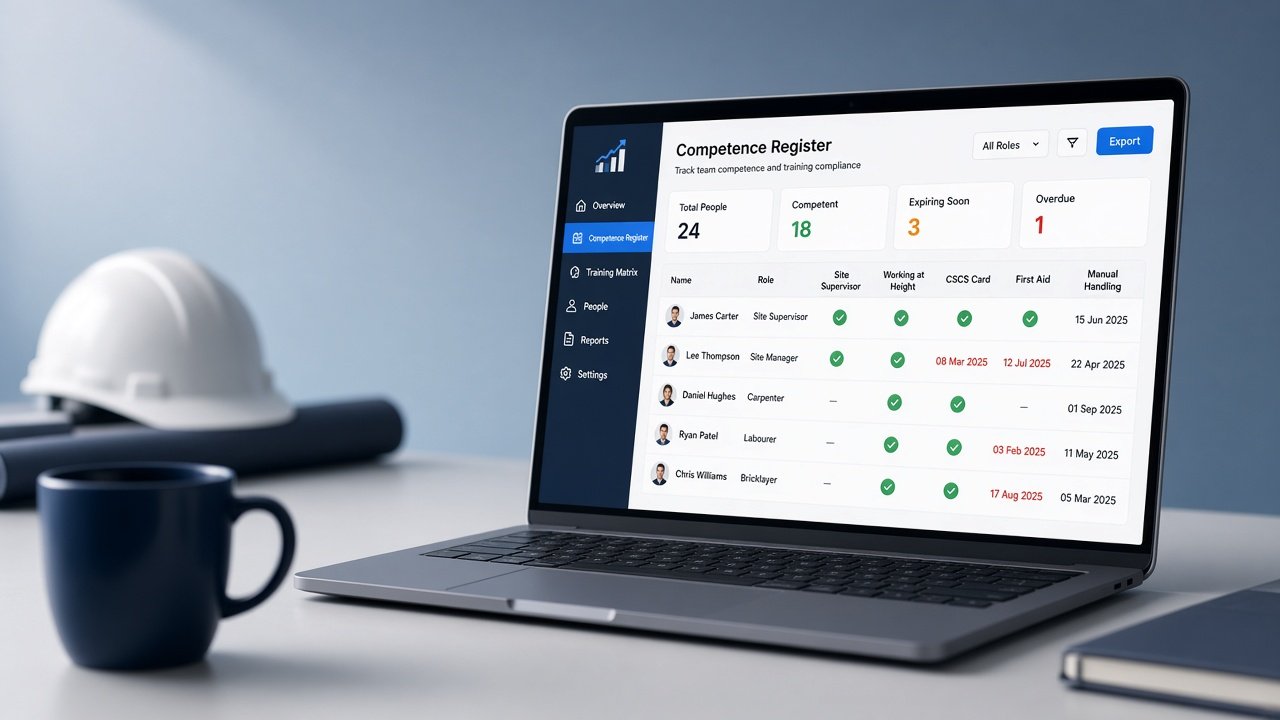
Digital competence register on a laptop for a construction SME ISO system

ISO competence is not a wall of colour-coded spreadsheets. For a construction or contracting SME in Scotland or elsewhere in the UK, ISO 9001 and ISO 45001 ask something simpler: people who affect quality and health and safety can do the work, and you can show how you know that.

If an ISO consultant has left you with five matrices nobody trusts, the problem is the design, not the standard.

What ISO competence actually requires

Clause 7.2 of ISO 9001 (and the matching competence requirement in ISO 45001) is about determining what competence you need, making sure people have it, and retaining appropriate documented information as evidence.

It does not demand:

  • A separate matrix for every client portal
  • Annual re-approval of skills everyone uses every week
  • A novel for each toolbox talk

It does demand that you can answer, without panic: who is allowed to do this task, on what basis, and where is the current proof?

For construction that usually means trade tickets, CSCS or equivalent, plant cards, inductions, method-statement briefings, and any role-specific training your risk assessment or client rules require. Keep the list tied to real risk and real contracts, not to every imaginable course brochure.

Why competence admin balloons

The usual pattern on site businesses:

  1. Someone builds a giant matrix “for ISO”.
  2. Site managers keep a second list in WhatsApp or a notebook.
  3. HR or the office keeps certificates in email folders.
  4. Client portals get a third upload of the same PDFs.
  5. Before UKAS Stage 2 or surveillance, someone spends a week chasing expired cards.

That is not competence management. That is duplicate filing. It is also why owners conclude an HSEQ consultant construction engagement means hiring a full-time administrator. It does not, if the system is lean.

One source of truth beats five lists

A proportionate approach an ISO consultant UK buyers can defend in audit:

  • One live register (or shared drive structure) as the master for people who affect the system
  • Each person linked to the roles or tasks they actually do
  • Evidence files that are the current certificate or induction record, not a photocopy of a photocopy
  • Expiry or renewal dates where the ticket or course has a real end date
  • Site access packs pulled from that same source, not rebuilt from scratch for every principal contractor

Document control for competence is version control: the right card, in the right place, obsolete copies removed. A matrix that is wrong is worse than a short list that is right.

Construction examples that usually matter

Prioritise what changes risk or blocks access:

  • Plant and lifting tickets for the kit you actually use
  • Asbestos awareness or licensed work where the work demands it
  • Hot works, confined space, or working at height where your method statements say so
  • First aid and fire marshal where your legal and site rules require cover
  • Induction and briefing records for the job, not a generic corporate slideshow nobody remembers

Skip the decorative rows. If nobody on your sites ever needs a skill, do not invent a column for it “in case the auditor asks”. UKAS-accredited assessors prefer a short, accurate picture over a padded one.

Integrated management system, one competence spine

If you run quality, environment, and health and safety together, you do not need three competence systems for ISO 9001, ISO 14001, and ISO 45001. An integrated management system can share people records, training evidence, and awareness. Add environmental or H&S-specific competence only where the role genuinely needs it (for example waste carrier awareness for someone who books skips, or first aid for nominated people).

That is the same proportionate logic Accendo uses for construction SMEs chasing UKAS-credible certification without bureaucracy.

What UKAS assessors usually sample

Expect sampling, not a full HR audit of every employee since founding. Assessors often pick a few people on the organogram or on a live site, ask what they do, and ask for the evidence that supports that role. Gaps show up when:

  • The matrix says trained, the person says they never were
  • The certificate on file is expired and nobody noticed
  • Agency or subcontractor people are treating your sites with no competence check at all
  • Inductions exist as a blank template, never completed for the job in question

Close those loops and most competence nonconformities disappear.

Accendo’s take

Accendo Consultants helps construction and engineering SMEs in West Lothian, across the central belt, and UK-wide build lean ISO systems that match how the business already works. Competence should be a living access and risk control, not a spreadsheet hobby.

If your matrices disagree with each other, or with the people on site, that is the fix: one source of truth, risk-based rows, current evidence, and a clear owner. If you want an ISO 9001 consultant Scotland review of your competence and training trail before Stage 2 or surveillance, or a look at our Lean IMS option for ISO 9001, 14001 and 45001, get in touch via https://accendo.org.uk/.

Accendo Consultants: lean ISO, UKAS-credible, built for how you work.
https://accendo.org.uk/
No time for ISO 9001 evidence? Then decide if you really want the certificate

Laptop checklist and time blocks for resourcing ISO 9001 evidence on a construction SME

A lot of construction SMEs say the same thing when the ISO work lands on someone’s desk: “We do not have the time,” “We do not have the resource,” “We cannot get evidence uploaded.” Sometimes that is a real capacity problem. Often it is an excuse for not deciding whether the certificate is actually wanted.

ISO 9001 is not a badge you buy. It is a management system that needs people, time and evidence. If your business will not allocate those, you should stop chasing the certificate until leadership is honest about what it wants.

What ISO 9001:2015 actually expects on resources

Drawn from ISO 9001:2015 (paraphrased, not full text):

  • Clause 5.1.1 e) Top management must ensure the resources needed for the QMS are available. Accountability for effectiveness and supporting people so they can contribute sits in the same leadership clause.
  • Clause 5.3 Responsibilities and authorities for QMS roles must be assigned and communicated. Someone has to own the work.
  • Clause 7.1.1 Determine and provide resources to establish, implement, maintain and continually improve the QMS, including what you must get from outside when internal capacity is limited.
  • Clause 7.1.2 Determine and provide the people needed for effective QMS implementation and for operating and controlling processes. This is the clearest “you need bodies and time” requirement.
  • Clause 7.1.3 Provide and maintain the infrastructure you need, including ICT. Portals and evidence uploads count.
  • Clause 7.2 Make sure people whose work affects the QMS are competent, close gaps, and retain documented information as evidence of competence.
  • Clauses 7.5.1 and 7.5.3 The QMS needs the documented information the standard requires and what you need for effectiveness, controlled so it is available and suitable when needed. Evidence does not upload itself.
  • Clause 8.1 c) When planning operations, determine the resources needed to achieve conformity.

If nobody owns evidence uploads, nobody gets time blocked for internal audit or management review, and site teams treat “ISO” as someone else’s hobby, you do not have a system. You have a folder and a hope. That sits poorly against leadership and resource requirements in 5.1.1 and 7.1 / 7.1.2.

Accendo’s reading for construction SMEs is simple: resource is a leadership decision. Saying “we are too busy winning work” while still demanding a UKAS certificate for the next PQQ is trying to have both without paying either price.

Evidence is not bureaucracy for its own sake

Clients often push back hardest on uploading evidence: toolbox talks, inspection records, supplier checks, nonconformity close-out, training. In a lean system those records should mostly come from work you already do on jobs. The resource ask is not “invent a second paperwork mountain.” It is “someone must collect, name and store what you already produce, on a rhythm the auditor can follow,” which is how clause 7.5 control of documented information shows up in real life.

If that someone does not exist, or they have zero hours in the week, certification will stall or fail Stage 2 / surveillance for predictable reasons. That is not the consultant being awkward. That is the standard doing what it says.

Decide what you want

Be blunt with yourself:

  • If you need UKAS-accredited ISO 9001 to win or keep contracts, you need a named owner, protected time, and a habit of evidence. Budget for that the same way you budget for plant or estimating.
  • If you only want a logo and will not resource the system, do not start. Non-UKAS shortcuts and empty manuals waste money and still fail serious buyers.
  • If capacity is genuinely tight this quarter, pause the project, pick a restart date, and tell your certification body and consultant the truth. Delaying with honesty beats ghosting evidence requests for months.

“We do not have resource” is a valid reason to wait. It is not a valid reason to expect Accendo (or any ISO consultant) to magic a certificate while the business refuses to engage.

What a resourced lean ISO 9001 looks like

For the construction and engineering SMEs Accendo supports in Scotland and across the UK, “enough resource” is usually modest and specific:

  1. A management representative or quality lead with clear hours, not a title and no diary space (clause 5.3 made real).
  2. Directors who attend management review and unblock issues, not only sign a policy.
  3. Site and office habits that create evidence as work happens (photos, forms, portal uploads), so you are not hunting files the week before the audit.
  4. A short, live system: processes people use, not a binder nobody opens.

That is lean ISO, UKAS-credible, built for how you work. It still needs someone to do it.

Bottom line for ISO 9001 consultant buyers

If leadership will not allocate people and time for evidence and system operation, that conflicts with ISO 9001:2015 clauses 5.1.1 and 7.1 / 7.1.2. You probably should not be pursuing the certificate right now. Figure out what you actually want: the contracts that need UKAS ISO, or the comfort of saying you are “working towards it” with no capacity behind the words.

When you are ready to resource it properly, Accendo can help you build a lean system that fits construction reality.

Contact us today at andrew@accendo.org.uk if you want a straight conversation about whether you are ready for ISO 9001, or what minimum resource a credible plan needs.

Accendo Consultants: lean ISO, UKAS-credible, built for how you work.