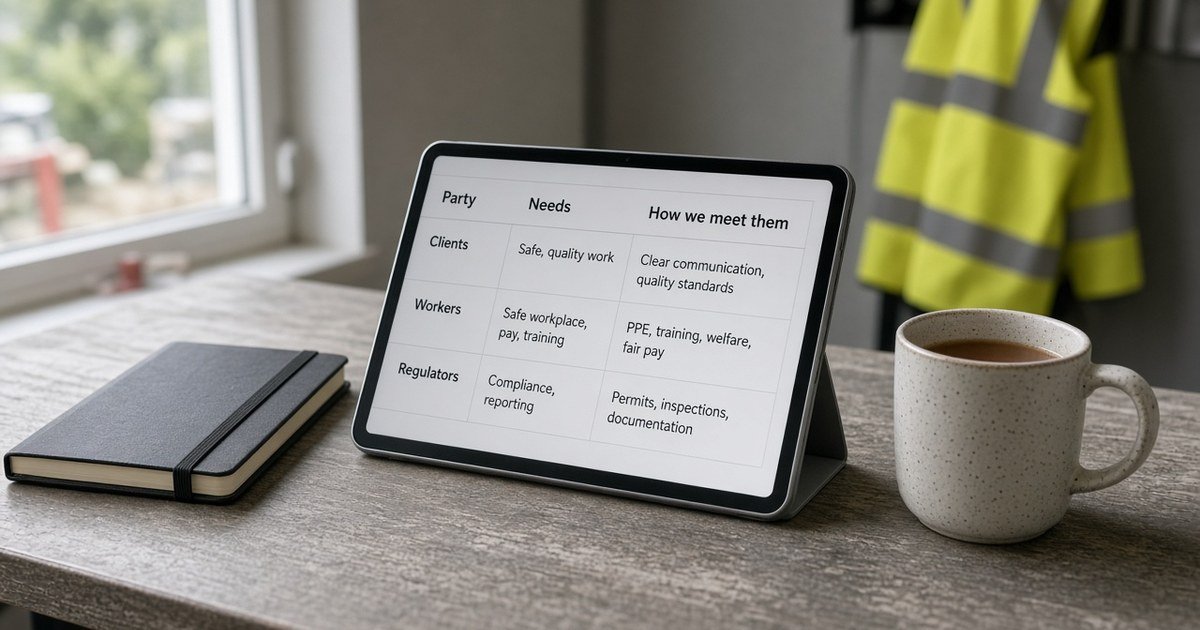
ISO interested parties are the people and bodies whose needs actually shape your management system, not a phone book of everyone you deal with. For a construction SME, ISO 9001 clause 4.2 is a short table: who matters, what they need, and how you already meet it. That is what a UKAS assessor wants to see.
As ISO consultants working with UK contractors, we still find interested-parties lists that run to several pages. Every supplier, every neighbour of every site, and every possible regulator gets copied from a template, then left untouched. Nobody on site uses it, and it does very little for the audit. Here is what the standards actually ask for, and a lean way to do it.
What does clause 4.2 actually require?
In ISO 9001, ISO 14001 and ISO 45001 you need to:
- Decide which interested parties are relevant to the management system.
- Decide what their relevant needs and expectations are.
- Monitor and review that information.
ISO 14001 also asks you to determine which of those needs become compliance obligations. ISO 45001 puts workers, and their representatives where they exist, firmly in the picture. You do not need three separate lists if you run an integrated management system for ISO 9001, 14001 and 45001. One table can cover all three, with a note of which standard a party is most relevant to.
Since the 2024 amendments, the standards also expect you to consider whether interested parties have climate-related requirements. For most contractors that is a line against the relevant clients or regulators, not a new register. The ISO 9001:2026 update includes clearer wording on interested parties. It does not ask you to lengthen the list. It still wants relevant parties and relevant needs, used in the system.
Notice what is missing. There is no requirement to map every stakeholder in detail, to keep a contacts directory, or to produce a long annual essay. Relevance is the test.
Who actually belongs on a contractor’s list?
For a typical construction or contracting SME, the relevant parties usually look like this:
- Clients and principal contractors. Programme, quality, site rules, and often a UKAS ISO certificate or SSIP membership as a condition of tender.
- Workers and their representatives. Safe work, competence, consultation and welfare. This matters on every ISO 45001 system.
- Regulators. HSE, the environmental regulator for where you work, building safety, waste duties and CDM roles that actually apply to you.
- Key subcontractors and suppliers. Only those whose work or materials can affect quality, safety or environmental performance, not every trade account.
- Insurers. Conditions of cover and the risk controls they expect to see.
- Neighbours and the local community. Noise, dust, hours and traffic, especially on occupied or urban sites.
- Your certification body. Accurate scope, access to sites and records, and timely close-out of findings.
- Prequalification and scheme owners. CHAS, Constructionline, SafeContractor or other SSIP and PQQ requirements that your clients actually ask for.
That is usually eight to twelve rows, not fifty. Leave out parties whose needs never change a decision. Your stationery supplier does not belong here. A waste carrier whose licence you must check does.
What should the table actually contain?
Four columns are enough:
- Interested party
- Relevant needs and expectations
- How you meet them (the process, record or control you already have)
- Which standard, if it helps (ISO 9001, 14001 or 45001)
Keep the needs specific. “Customer satisfaction” is too vague to be useful. “Principal contractor requires a UKAS ISO 9001 certificate and an in-date SSIP” is something you can act on. “Workers expect consultation on method changes that affect safety” points to a real process. “Neighbours expect noisy works to stay inside agreed hours” points to a site control.
The “how you meet them” column is what makes the table worth having. It should point to things you already run: contract review, induction, the legal register, waste documentation, consultation records, insurance reviews, or your SSIP evidence pack. A UKAS assessor follows that link. A list with no link to the rest of the system is just a phone book.
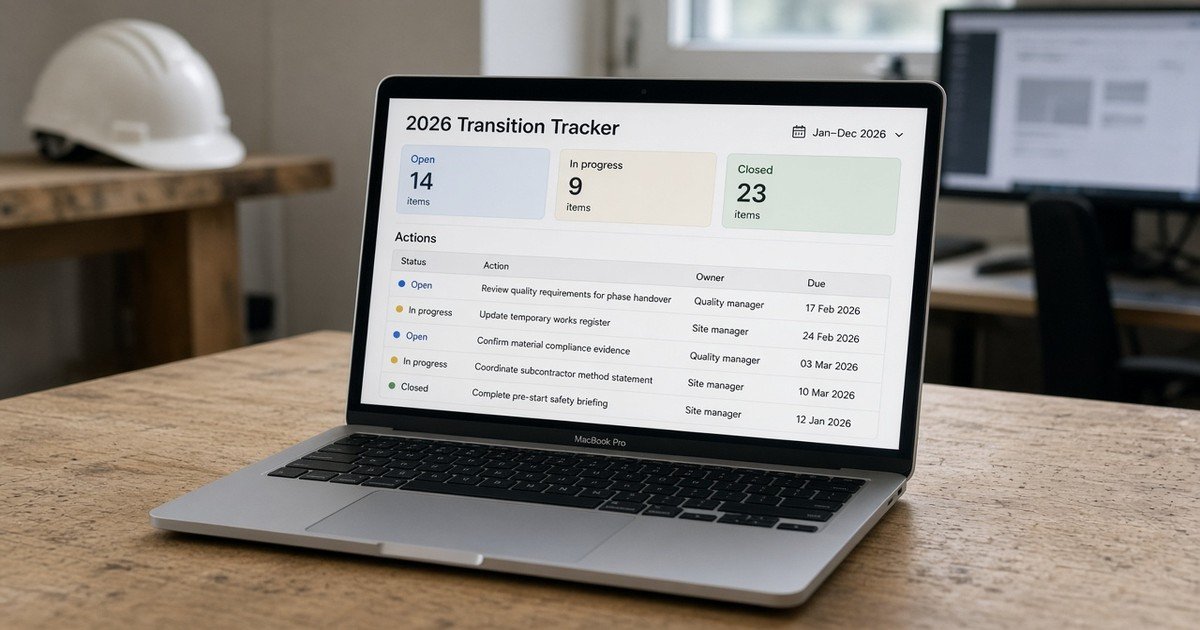
Keep the table somewhere live, such as a shared document on SharePoint or OneDrive, so it is easy to update at management review and easy to show on screen at audit.
Do you need to update it every year?
No. The standards ask you to monitor and review the information, not to rewrite the document. The natural place to do that is your management review. A short minute such as “interested parties reviewed, new framework client added, no other changes” is perfectly good evidence.
Update the table itself when something real changes: a new type of client, a major contract with new conditions, a new regulation, a move into a different region, or a complaint from neighbours that changes how you work. If nothing has changed, say so and move on. An unchanged table with a dated review is more credible than a freshly expanded list that nobody uses.
What does a UKAS assessor look for?
At Stage 1 and during surveillance, an assessor will usually check that:
- You can explain who matters and why, in your own words, not by reading a generic template.
- The needs are realistic and specific to your business.
- The list matches how you actually work. If most of your work comes from one principal contractor, that contractor should be on the table. If you hold ISO 45001, workers should be on it too.
- Those needs show up somewhere else: risks and opportunities, the legal register, objectives, operational controls, or management review decisions.
- Climate-related needs have been considered where they are relevant.
- The information has been reviewed, and updated when the business changed.
The common weak spot is not a missing document. It is a long, generic list that never mentions the client who sets most of your site rules, or that treats workers as an afterthought on a health and safety system.
How does this sit with context of the organisation?
Interested parties sit next to context of the organisation. Clause 4.1 is the issues that affect the business. Clause 4.2 is the people and bodies whose needs drive the system. One short working session can produce both: a one-page context note and this table. You do not need a separate project for each.
Where does Accendo fit?
We help construction and contracting SMEs across the UK, and as ISO consultants in Scotland (West Lothian, Edinburgh and Glasgow), get interested parties right in a short working session: a realistic table, needs that point to real controls, and a review habit that sits inside management review. Lean, proportionate, and ready for a proper UKAS certification body audit.
Contact us today at andrew@accendo.org.uk.
Accendo Consultants: lean ISO, UKAS-credible, built for how you work.