
Planning your ISO 9001:2026 and ISO 14001:2026 transition does not automatically mean buying a new manual. If you already run an integrated management system around how the work is done, the lean move for a construction or contracting SME in Scotland or elsewhere in the UK is to update what works, add only what is justified, and keep a clear track of the actions.
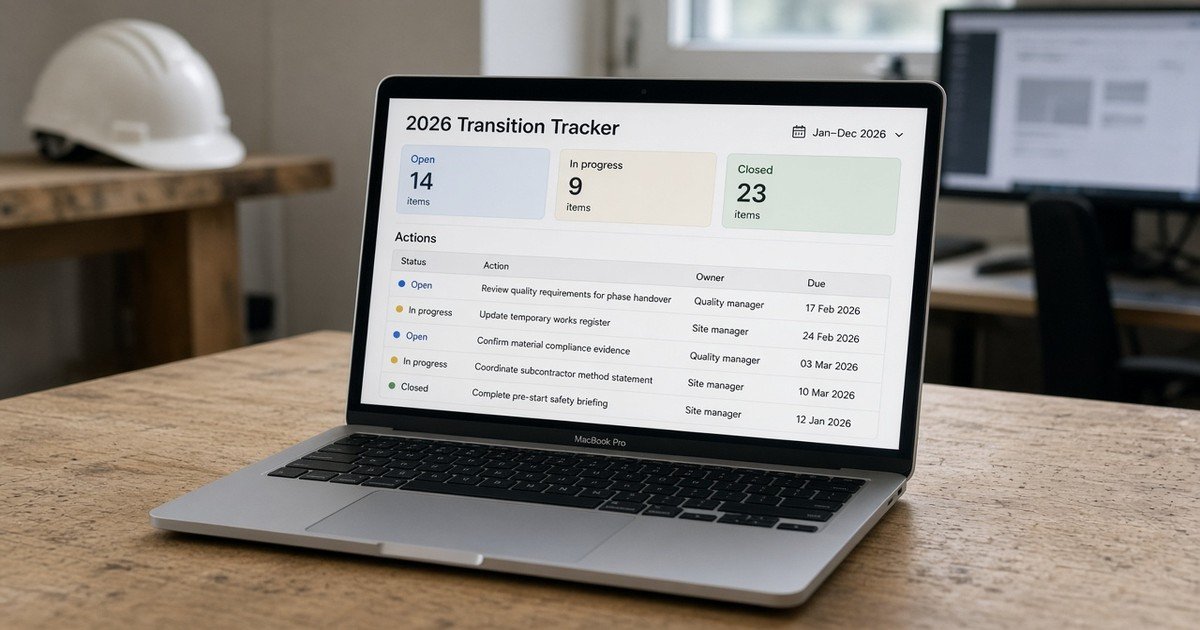
Accendo is developing a practical dashboard for that ISO 9001:2026 transition. It helps the consultant and the client see existing records, real gaps, owners, due dates, progress, internal audit results and the evidence a certification body visit would sample. AI helps us sort the reading. A consultant reviews the result before any client action is finalised. The dashboard does not certify anyone.
What is an IMS, and why keep the one you already use?
An integrated management system, or IMS, is the single set of procedures, registers, forms and site controls you already use to run quality, environment and, where relevant, health and safety together. For an owner-led construction firm, it should look like how you tender, plan and work on site, not a second company invented on paper.
Replacing your system with a template pack can mean rewriting controls that already work. We start from the system you have. Where does the revised text already match what you do? Where is a small addition enough? Where is there a genuine gap?
We have already set out how we map the 2026 updates against an IMS and produce a gap analysis. This post is about the next step: turning that map into tracked actions.
How does Accendo use AI without handing it the certificate?
We use AI-assisted comparison to help sort clause wording into plain groups: new, changed, moved, editorial or unchanged. The aim is the minimum additions a working IMS may need, not extra procedures. That comparison supports consultant-led checking. It is not a definitive, audited reading of every clause. A consultant checks the official standards and relevant guidance before any client action is treated as final.
The quality themes we are looking at include how risks and opportunities are considered, quality culture and ethical behaviour, follow-through on planned changes, interested parties, and review and audit inputs. The environmental themes include planning of changes, environmental context (including biodiversity and ecosystems where relevant), interested parties, and emergency situations. If you already covered climate change in your context review, that work carries forward.
What does the practical dashboard actually track?
The dashboard is a working view of one client system at a time. It brings together:
- the records you already keep, such as registers, change logs and review agendas
- candidate gaps, each with a suggested minimum action, an owner and a due date
- progress, so open, in progress and closed items are visible
- internal audit results, kept separate from the certification body visit
- a simple map of evidence the assessor may want to sample
This is a developing practical approach, not a live automatic feed from client folders or a completed multi-client transition. Some views used while we build the method are illustrations, not finished mappings of real companies. The point is to make the work visible: what to change, who owns it, and when it will be checked.
What does a typical update look like in practice?
This walk-through is hypothetical, not a completed client result.
Imagine a contractor already has a risk and opportunity register and a management review agenda. The comparison flags that risks and opportunities may need to be considered more clearly as separate points, and that planned changes should show who was told, how the change was followed through, and how the result was reviewed. That is a potential gap, not a finished finding.
A consultant then checks the official requirement and the evidence already on file. If the register already does the job, the action may be a clearer column, not a new procedure. If the change log is thin, the minimum justified action might be to extend that log, name an owner and set a due date.
The same pattern can apply to a line in induction on quality culture and ethics, an extra column on an interested parties table, or a check that biodiversity, ecosystem health and emergency situations are considered where they are relevant. Internal audit later samples whether the updates are in use. The dashboard then shows the status and the evidence that would help at a certification body visit. Accendo prepares clients. The certification body certifies.
How Accendo can help
If you want an ISO consultant in Scotland or elsewhere in the UK to track ISO 9001:2026 and ISO 14001:2026 against your existing IMS, without buying a new manual, we can help. Our integrated management system for ISO 9001, 14001 and 45001 is built around how you work, not around paperwork for its own sake. Contact us today at andrew@accendo.org.uk.
Accendo Consultants: lean ISO, UKAS-credible, built for how you work.