Statutory Inspections Register for ISO 45001 Contractors

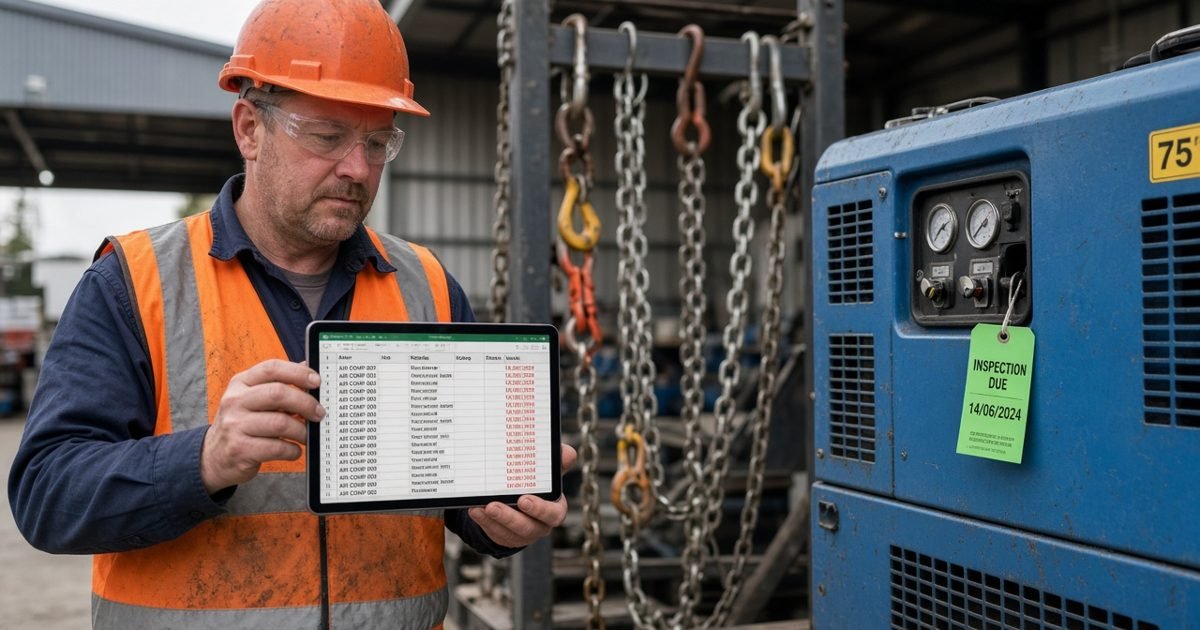
Site supervisor in hi-vis and hard hat holding a tablet showing a digital equipment inspection register beside an air compressor with an inspection tag and lifting chains in a contractor's yard

A statutory inspections register is one of the quickest wins for an ISO 45001 contractor. It is a single list of the equipment and installations the law says must be inspected or examined, who does it, when it was last done and when it is next due. For construction SMEs, it is also one of the first places a UKAS assessor looks when they want to know whether your health and safety system actually works.

This guide is for UK contractors and owner-led firms, including those working towards ISO 45001 in Scotland, who want inspection dates under control without building another spreadsheet nobody opens.

What does ISO 45001 expect for inspections?

ISO 45001 does not list inspections by name. It asks you to know your legal requirements, control your risks, and monitor and measure whether those controls are working. Statutory inspections sit right across all three. If a regulation says a piece of equipment must be examined by a competent person, ISO 45001 expects you to know that, plan it and keep the evidence.

So the assessor’s question is simple: can you show that everything which needs a legal inspection has one, and that nothing has quietly gone overdue?

Which inspections usually belong on the register?

Every business is different, so build your list from the equipment you actually own, hire and use. For many construction and engineering SMEs it will include some of these:

  • Lifting equipment and accessories under LOLER 1998, such as hoists, slings, chains, shackles and mobile elevating work platforms. Thorough examination intervals are set by the regulations or by a written scheme.
  • Pressure systems under the Pressure Systems Safety Regulations 2000, such as air compressors and receivers. These need a written scheme of examination and examinations by a competent person at the intervals it sets.
  • Local exhaust ventilation under COSHH, such as on-tool extraction and dust units, which needs a thorough examination and test.
  • Electrical installations and portable equipment under the Electricity at Work Regulations 1989, such as the fixed installation at your yard or office and the tools that go to site.
  • Work equipment under PUWER 1998, where conditions on site can cause deterioration and lead to danger.
  • Scaffolds and excavations, where the Work at Height Regulations 2005 and CDM 2015 require inspections by a competent person before use and at set points.
  • Fire safety equipment at your premises, such as extinguishers, alarms and emergency lighting.

Hired equipment counts too. The hire company usually holds the examination certificate, but you should still be able to show you checked it was in date before the kit was used.

What should each line on the register show?

Keep it short. Each line needs:

  • The item, with an asset number or serial number so it can be traced.
  • The legal requirement or reason it is on the list.
  • Who carries out the inspection or examination (in-house competent person, insurer’s engineer or specialist contractor).
  • The date last done and the date next due.
  • Where the certificate or report is kept.
  • Any defects found and how they were closed.

A shared spreadsheet, a Microsoft List or the asset module in your existing software is fine. What matters is that one person owns it and that due dates are visible before they arrive, not after.

What does a UKAS assessor actually sample?

Assessors rarely read the whole register. They pick a few items and follow the trail. Typically they will:

  • Choose an item they saw on site or in the yard and ask to see its latest examination report.
  • Check the report is in date and that any defects flagged have been dealt with.
  • Ask how you know when the next one is due, and who is responsible.
  • Look for equipment in use that is not on the register at all.

That last point is the one that catches people out. A compressor bought last spring, or a new set of lifting accessories, that never made it onto the list is a gap in your planning, not just your paperwork.

How do you keep it lean?

The register does not need to be a project. A few habits keep it under control:

  • Add items when you buy or hire them. Make “add to inspection register” part of your purchasing step, not something you remember at audit time.
  • Use reminders, not memory. Put the next due dates into a shared calendar or set alerts a month ahead so there is time to book the engineer.
  • Link to the reports. Store certificates in one folder and link to them from the register, rather than printing copies.
  • Review it at management review. One line in your management review on overdue or upcoming inspections is enough to show top management oversight.
  • Remove what you no longer have. Disposed or returned equipment should come off the list with a note, so the register stays honest.

If you already have a calibration list for ISO 9001, you can run both from the same register. Our post on ISO 9001 calibration for construction tools shows how that side works.

Where does this fit in your management system?

The inspections register is a small part of a working integrated management system. It ties your legal register, your risk assessments and your monitoring together in one place. If you are adding ISO 45001 to an existing system, or want an ISO 45001 consultant to check what you have before the certification body visits, our Lean IMS for ISO 9001, 14001 and 45001 is built to keep this kind of record simple and audit ready.

Contact us today at andrew@accendo.org.uk.

Accendo Consultants: lean ISO, UKAS-credible, built for how you work.
COSHH Records for ISO 45001: What Contractors Need

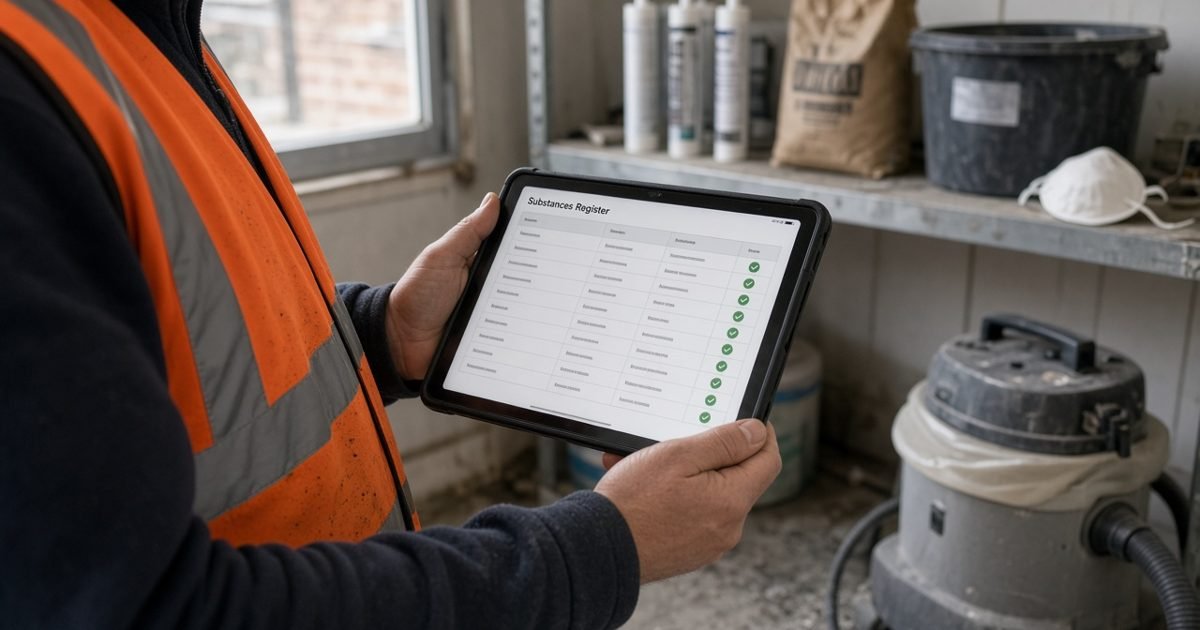
Site manager in hi-vis holding a tablet showing a digital COSHH substances register beside a shelf of labelled construction chemicals in a site cabin, natural daylight

The COSHH records an ISO 45001 contractor actually needs are fewer than most binders suggest: a list of the substances you really use, a short assessment for each one or each task, the controls that go with it, and proof those controls are checked and briefed on site. For construction SMEs, that is the core of what a UKAS assessor will sample, and it is also what the law already asks of you.

This is practical advice for UK contractors and owner-led firms, including those working towards ISO 45001 in Scotland, who want COSHH to work on live jobs rather than sit in a cupboard.

What does ISO 45001 expect for COSHH?

ISO 45001 does not have a COSHH clause. It asks you to identify hazards, assess the risks, know your legal requirements, put controls in place and check they work. For hazardous substances in Great Britain, the legal requirement behind that is the Control of Substances Hazardous to Health Regulations 2002 (COSHH). So the ISO 45001 question is simple: can you show you meet COSHH on the work you actually do?

That means the assessor is less interested in how thick the COSHH file is and more interested in whether the assessment on file matches the product in the van, and whether the operative using it knows the controls.

Which COSHH records do construction SMEs actually need?

For most contractors, a lean and defensible set looks like this:

  • A substances list. One register of the products and processes you use, with the supplier, where it is used and a link to the current safety data sheet. Keep it to what is really on site and in the yard.
  • COSHH assessments. A short assessment for each substance or, often better, for each task. If you employ five or more people, the significant findings must be recorded.
  • Process-generated hazards. Dust and fume made by the work, such as silica dust from cutting, drilling or chasing, wood dust and welding or diesel fume. These have no safety data sheet, so they are the ones most often missed.
  • Control measures. On-tool extraction, water suppression, ventilation, substitution of a less harmful product, and the right RPE, gloves and eye protection for the task.
  • Checks on the controls. Local exhaust ventilation (LEV) must have a thorough examination and test at least every 14 months. Face-fit testing for tight-fitting RPE. Simple pre-use checks for extraction and masks.
  • Health surveillance, where it applies. For example, skin checks for regular cement or resin work, or lung function checks where there is significant exposure to certain dusts. Where health surveillance is required, the records must be kept for at least 40 years.
  • Information, instruction and training. A toolbox talk or RAMS briefing that covers the substance and its controls, with a record of who attended.

That is it for most firms. You do not need a separate 20-page assessment for every tin of paint or a copy of every safety data sheet printed and filed.

Is a safety data sheet the same as a COSHH assessment?

No. This is the most common gap we see. A safety data sheet tells you about the product. A COSHH assessment tells you how your people use it, how much, for how long, where, and what controls you put in place. An assessor will usually ask to see both, and will check that the assessment reflects how the task is really done.

Keep safety data sheets current and easy to find, ideally linked from your substances list in the system you already use. Then write the assessment around the task.

How do you keep COSHH records lean but credible?

  • Assess by task where you can. One assessment for cutting and chasing masonry covers several products and the dust they make. It is easier to brief and easier to keep up to date.
  • Put the controls in the job pack. If the RAMS for a job do not mention the extraction, RPE or welfare needed for the substances on that job, the assessment is not doing its work.
  • Review on change. New product, new supplier, new task, an incident or ill-health report. Also review on a set cycle in the same register you use for other risk assessments.
  • Clear out what you no longer use. Old products on the list make the register look unmanaged and waste everyone’s time.
  • Give each record an owner. Someone who can explain the controls and show the latest check.

What will a UKAS assessor sample on site?

Expect the assessor to pick a live task, often cutting, drilling, painting, sealing or cleaning, and follow it through. They may ask which products are in use, then look for the assessment, the safety data sheet, the controls on the job, the RPE and its face-fit record, the LEV test date on any extraction, and the briefing record for the people doing the work. They will also check that COSHH sits in your legal register and hazard identification, not in a separate folder no one opens.

If the record and the site match, it is a short conversation. If they do not, it is usually a finding, even when there is a lot of paperwork.

Where does Accendo fit?

We help construction and contracting SMEs across the UK, and as ISO 45001 consultants in Scotland (West Lothian, Edinburgh and Glasgow), set up COSHH records that match the work and stand up at a UKAS-accredited assessment. If you are adding health and safety to a quality or environmental system, see our guide to adding ISO 45001 to an existing 9001 or 14001 system, or our integrated management system for ISO 9001, 14001 and 45001.

Contact us today at andrew@accendo.org.uk.

Accendo Consultants: lean ISO, UKAS-credible, built for how you work.
Add ISO 45001 to an Existing 9001 or 14001 System

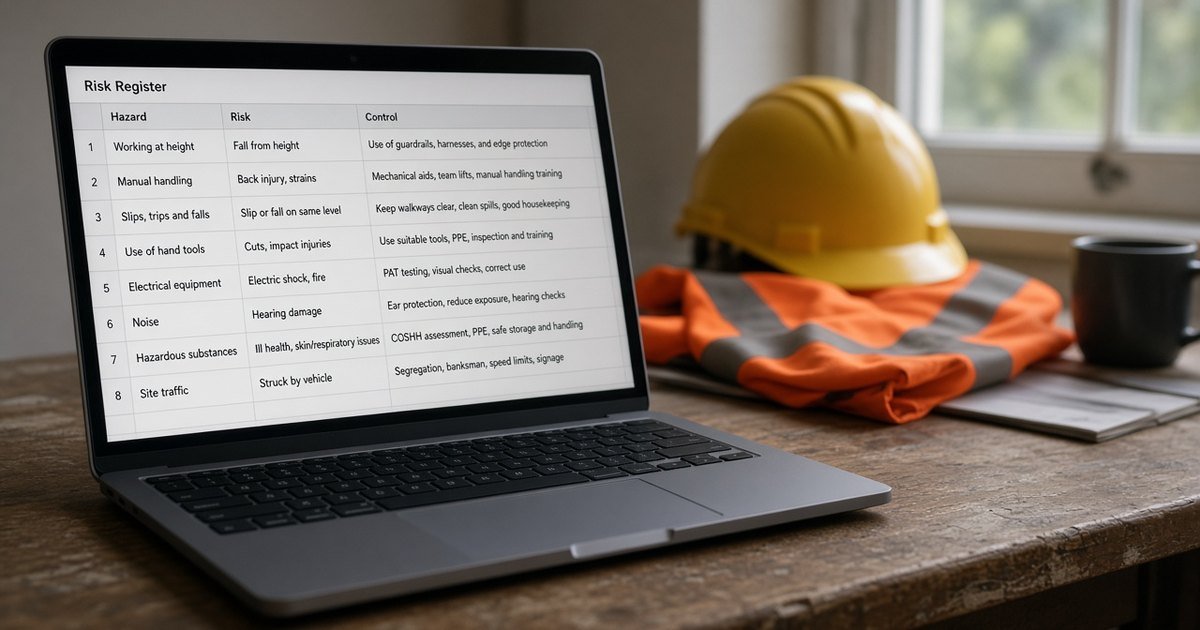
Laptop on a construction site-office desk showing a digital health and safety risk register, with a hard hat and hi-vis vest in the background and natural daylight from the window

You can add ISO 45001 to an existing ISO 9001 or ISO 14001 system without replacing the management system you already use. For most construction and contracting SMEs, the work is to extend the integrated system you have, not to write a second manual.

This is practical advice for UK contractors, including owner-led firms in Scotland, who already hold ISO 9001 or ISO 14001 and now need ISO 45001 for tenders, principal contractors, or a clearer way to run health and safety.

Why add ISO 45001 to a system you already have?

A quality or environmental certificate often gets you onto a list. A growing number of principal contractors and public buyers also want evidence of a structured health and safety system, and ISO 45001 is the standard they recognise. If your 9001 or 14001 system is already in use, you already have the spine of an integrated management system: context, leadership, planning, competence, operational control, internal audit, management review and improvement.

ISO 45001 uses the same high-level structure. That is why adding it should be an extension, not a restart. A separate health and safety manual that never meets the quality system is extra work, and assessors notice when the two do not match.

Do you have to rewrite the whole IMS?

No. Keep the procedures, registers and meeting rhythm that already work. Add the occupational health and safety content where it belongs, and leave the rest alone.

In practice that means one manual, one document register, one internal audit programme and one management review, with ISO 45001 in the same places you already cover 9001 and 14001. You will need some new or extended records, but you should not duplicate context statements, organograms or audit calendars just because a third standard has been added.

Talk to your UKAS-accredited certification body early about a scope extension. They will tell you how they will assess the new health and safety elements and how they sit in the system you already hold. Accendo can help you prepare, but we are not the certification body and we do not issue the certificate.

What actually needs to be added?

The distinctive ISO 45001 work is occupational health and safety, not another copy of the clauses you already meet. Typical additions for a contractor are:

  • A clear OH&S scope that covers the sites and activities you actually do, not only the office.
  • Hazard identification and OH&S risk assessment that matches the work: plant, work at height, lifting, traffic, welfare, subcontractors and occupational health, not a generic office list.
  • The legal requirements that apply to your work, kept in the legal register you already use, with owners who can show how they are met.
  • Consultation and participation of workers. This is stronger in ISO 45001 than in ISO 9001 or ISO 14001. Supervisors and operatives should have a real route to raise hazards and influence controls, and you should be able to show that it happens.
  • Competence and awareness for the tasks people actually do, building on the training records you already keep.
  • Operational controls that appear in the job pack: RAMS, inductions, permits, inspections and the briefing at the start of the job.
  • Incident investigation, first aid and emergency arrangements that are practised, not only written down.
  • OH&S objectives and a simple way to monitor them, reviewed in the same management review as quality and environmental objectives.

You do not need a procedure for every clause. You need evidence that the controls above are used on live jobs.

How do you use the records you already keep?

Most contractors already hold a large part of the evidence. Inductions, toolbox talks, training and competence records, accident and incident reports, site inspections, COSHH assessments, RAMS and equipment checks are all relevant if they are current and match the work. The gap is usually consistency: the same control on every site, an owner, and a place you can find the record when an assessor asks.

Pull those records into the system you already run. Do not start a parallel filing structure that only exists for ISO. If a risk assessment or induction is already used on site, that is the record. Make sure it is complete, dated and available, then show it in internal audit and management review.

What will a UKAS assessor look for?

On a scope extension, the assessor is not only checking that a health and safety section has been added to the manual. They will want to see the system in use: a live risk assessment for current work, competence for the people on that job, consultation that is more than a signed attendance sheet, and incidents that were investigated and closed.

They will also check integration. If your quality objectives, audits and management review ignore health and safety, or if the OH&S risks describe a different business to the one in your 9001 scope, that will be a problem. The same company should show up in all three places.

Keep the sample small and honest. A short, used set of records beats a thick unused pack. Our article on building one lean IMS across ISO 9001, 14001 and 45001 sets out the same idea from the other direction, when you are putting all three in place together.

Where does Accendo fit?

We help construction and contracting SMEs across the UK, and as ISO 45001 consultants in Scotland (West Lothian, Edinburgh and Glasgow), add ISO 45001 to a working 9001 or 14001 system without burying the business in a second set of procedures. That is the same thinking behind our integrated management system for ISO 9001, 14001 and 45001.

Contact us today at andrew@accendo.org.uk.

Accendo Consultants: lean ISO, UKAS-credible, built for how you work.
Close ISO Corrective Actions Before the Next Visit

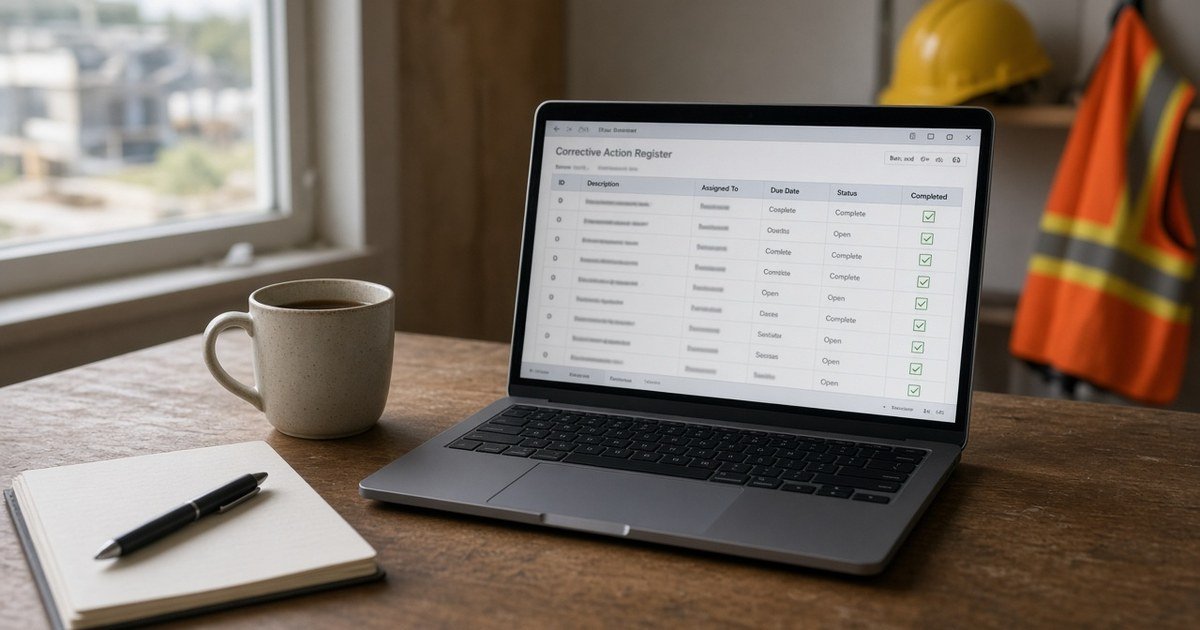
Laptop on a construction site-office desk showing a digital ISO corrective action register, with a hard hat and hi-vis vest in the background and natural daylight from the window

ISO corrective actions should be closed while the job is still fresh, not in the week before the auditor returns. An open list that has sat still since Stage 2, or since last year’s internal audit, is one of the first things a UKAS assessor will notice on a surveillance visit.

This is practical advice for construction and contracting SMEs in the UK, including owner-led firms in Scotland, who want a lean way to close findings properly before the next certification body visit.

Why do open actions matter at the next visit?

Surveillance is not a rerun of Stage 2, but it does check whether the system is still being used. Assessors typically look at progress on previous findings, and at how you handle new problems that have come up since: complaints, incidents, nonconformities and improvement actions. Our article on what surveillance actually checks covers the wider sample. The corrective action register is often the shortest route into that conversation.

If actions are still open with no owner, no date and no evidence of work, the assessor will reasonably ask whether the system is running. A short, honest register that shows what was raised, who owns it, and what changed is much stronger than a long list that never moves.

What does “closed” actually mean?

Closing an ISO corrective action is more than marking a row complete. For each finding, you should be able to show:

  • What was found, in plain language, and where.
  • The cause, at a useful level, not a one-word label such as “human error”.
  • What you changed, which might be a record, a briefing, a control on the next jobs, or, if the same gap kept appearing, a change to the way of working.
  • Evidence that the fix was done, and a simple check that it has stuck.
  • An owner and the dates you raised and closed it.

The certification body sets the timescales for findings they raised. Treat major nonconformities as urgent. Minors still need a proper cause, fix and check. A promise to look at it later is not closure.

Keep the response proportionate. A missing induction record on one site may need the record completed, a reminder to the supervisor, and a check on the next few jobs. It does not automatically need a rewritten procedure. The same gap on several sites might.

How do you keep a register people will actually use?

You do not need new software. The register you already have is enough if it is short, current and used. One list for certification body findings, internal audit actions, incidents and complaints is usually better than four spreadsheets nobody opens.

Review open actions in a meeting the business already has, such as an operations or directors’ meeting, not only in the quality folder. Name an owner who can actually do the work. Give a realistic date. If a date slips, record why and set a new one. Silent slippage is what assessors notice.

Do not raise actions you have no intention of closing. A long list of vague improvements makes the system look busy and then becomes a problem in its own right at the next visit.

What evidence should you keep?

File evidence that the gap is fixed, not only a completed form. A revised risk assessment, a completed training record, a job pack from the next site, or a dated register entry with an owner is more convincing than a paragraph of intent.

Keep it with the action, or in a place you can find quickly when the assessor asks. You should be able to talk through a closed item in a few sentences: what was wrong, what you did, and how you know it has not come back.

What if something cannot be fully closed yet?

Some actions take longer because they depend on a later job, a supplier, or a seasonal activity. That is fine if the register shows a real plan, progress so far, and a reason the item is still open. It is not fine if the row has sat untouched since the last visit.

If the same issue keeps returning, do not keep closing it as a one-off. Take it to management review and decide whether the control itself needs to change. Recurring findings are one of the clearest signals that the system is not doing its job.

Where does Accendo fit?

We help construction and contracting SMEs across the UK, and as ISO consultants in Scotland (West Lothian, Edinburgh and Glasgow), keep corrective actions lean and closeable, so the next UKAS visit is a check on a working system, not a scramble through last year’s list. That is the same thinking behind our integrated management system for ISO 9001, 14001 and 45001.

Contact us today at andrew@accendo.org.uk.

Accendo Consultants: lean ISO, UKAS-credible, built for how you work.
ISO 9001 Interested Parties: A Simple Table for Contractors

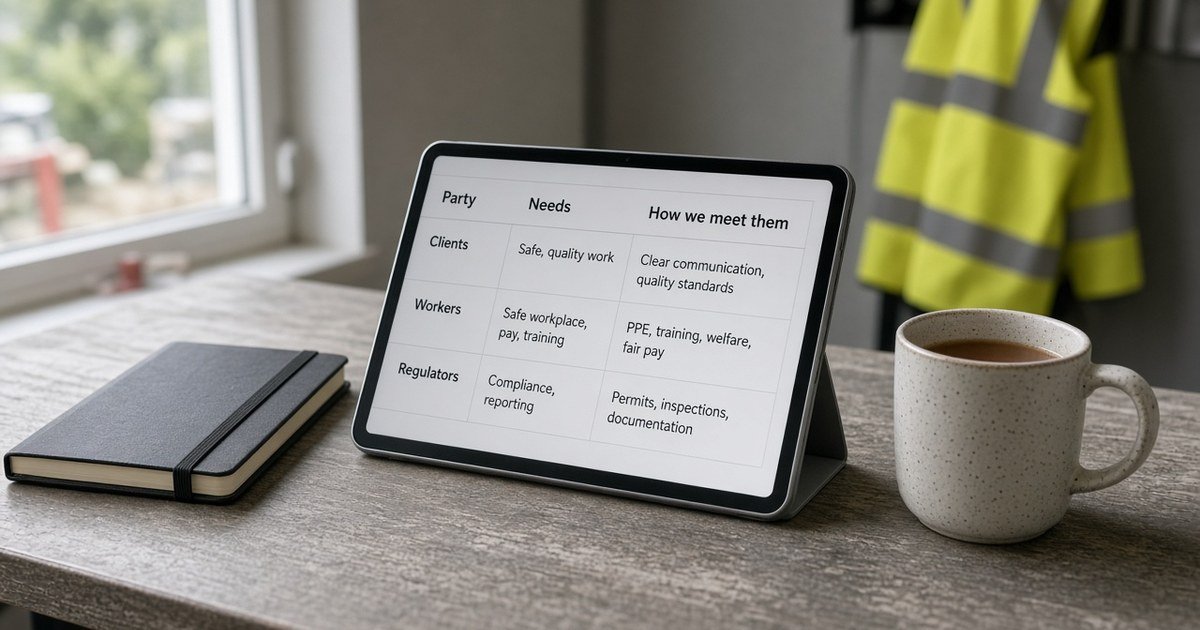
Tablet on a construction site-office desk showing a simple ISO interested parties table, with natural daylight through the window

ISO interested parties are the people and bodies whose needs actually shape your management system, not a phone book of everyone you deal with. For a construction SME, ISO 9001 clause 4.2 is a short table: who matters, what they need, and how you already meet it. That is what a UKAS assessor wants to see.

As ISO consultants working with UK contractors, we still find interested-parties lists that run to several pages. Every supplier, every neighbour of every site, and every possible regulator gets copied from a template, then left untouched. Nobody on site uses it, and it does very little for the audit. Here is what the standards actually ask for, and a lean way to do it.

What does clause 4.2 actually require?

In ISO 9001, ISO 14001 and ISO 45001 you need to:

  • Decide which interested parties are relevant to the management system.
  • Decide what their relevant needs and expectations are.
  • Monitor and review that information.

ISO 14001 also asks you to determine which of those needs become compliance obligations. ISO 45001 puts workers, and their representatives where they exist, firmly in the picture. You do not need three separate lists if you run an integrated management system for ISO 9001, 14001 and 45001. One table can cover all three, with a note of which standard a party is most relevant to.

Since the 2024 amendments, the standards also expect you to consider whether interested parties have climate-related requirements. For most contractors that is a line against the relevant clients or regulators, not a new register. The ISO 9001:2026 update includes clearer wording on interested parties. It does not ask you to lengthen the list. It still wants relevant parties and relevant needs, used in the system.

Notice what is missing. There is no requirement to map every stakeholder in detail, to keep a contacts directory, or to produce a long annual essay. Relevance is the test.

Who actually belongs on a contractor’s list?

For a typical construction or contracting SME, the relevant parties usually look like this:

  • Clients and principal contractors. Programme, quality, site rules, and often a UKAS ISO certificate or SSIP membership as a condition of tender.
  • Workers and their representatives. Safe work, competence, consultation and welfare. This matters on every ISO 45001 system.
  • Regulators. HSE, the environmental regulator for where you work, building safety, waste duties and CDM roles that actually apply to you.
  • Key subcontractors and suppliers. Only those whose work or materials can affect quality, safety or environmental performance, not every trade account.
  • Insurers. Conditions of cover and the risk controls they expect to see.
  • Neighbours and the local community. Noise, dust, hours and traffic, especially on occupied or urban sites.
  • Your certification body. Accurate scope, access to sites and records, and timely close-out of findings.
  • Prequalification and scheme owners. CHAS, Constructionline, SafeContractor or other SSIP and PQQ requirements that your clients actually ask for.

That is usually eight to twelve rows, not fifty. Leave out parties whose needs never change a decision. Your stationery supplier does not belong here. A waste carrier whose licence you must check does.

What should the table actually contain?

Four columns are enough:

  • Interested party
  • Relevant needs and expectations
  • How you meet them (the process, record or control you already have)
  • Which standard, if it helps (ISO 9001, 14001 or 45001)

Keep the needs specific. “Customer satisfaction” is too vague to be useful. “Principal contractor requires a UKAS ISO 9001 certificate and an in-date SSIP” is something you can act on. “Workers expect consultation on method changes that affect safety” points to a real process. “Neighbours expect noisy works to stay inside agreed hours” points to a site control.

The “how you meet them” column is what makes the table worth having. It should point to things you already run: contract review, induction, the legal register, waste documentation, consultation records, insurance reviews, or your SSIP evidence pack. A UKAS assessor follows that link. A list with no link to the rest of the system is just a phone book.

Keep the table somewhere live, such as a shared document on SharePoint or OneDrive, so it is easy to update at management review and easy to show on screen at audit.

Do you need to update it every year?

No. The standards ask you to monitor and review the information, not to rewrite the document. The natural place to do that is your management review. A short minute such as “interested parties reviewed, new framework client added, no other changes” is perfectly good evidence.

Update the table itself when something real changes: a new type of client, a major contract with new conditions, a new regulation, a move into a different region, or a complaint from neighbours that changes how you work. If nothing has changed, say so and move on. An unchanged table with a dated review is more credible than a freshly expanded list that nobody uses.

What does a UKAS assessor look for?

At Stage 1 and during surveillance, an assessor will usually check that:

  • You can explain who matters and why, in your own words, not by reading a generic template.
  • The needs are realistic and specific to your business.
  • The list matches how you actually work. If most of your work comes from one principal contractor, that contractor should be on the table. If you hold ISO 45001, workers should be on it too.
  • Those needs show up somewhere else: risks and opportunities, the legal register, objectives, operational controls, or management review decisions.
  • Climate-related needs have been considered where they are relevant.
  • The information has been reviewed, and updated when the business changed.

The common weak spot is not a missing document. It is a long, generic list that never mentions the client who sets most of your site rules, or that treats workers as an afterthought on a health and safety system.

How does this sit with context of the organisation?

Interested parties sit next to context of the organisation. Clause 4.1 is the issues that affect the business. Clause 4.2 is the people and bodies whose needs drive the system. One short working session can produce both: a one-page context note and this table. You do not need a separate project for each.

Where does Accendo fit?

We help construction and contracting SMEs across the UK, and as ISO consultants in Scotland (West Lothian, Edinburgh and Glasgow), get interested parties right in a short working session: a realistic table, needs that point to real controls, and a review habit that sits inside management review. Lean, proportionate, and ready for a proper UKAS certification body audit.

Contact us today at andrew@accendo.org.uk.

Accendo Consultants: lean ISO, UKAS-credible, built for how you work.

What to Do After an ISO Stage 2 Closing Meeting

Laptop and notes on a site-office table after an ISO Stage 2 closing meeting, with a digital action list on screen

The ISO Stage 2 closing meeting is not the finish line. It is the moment the auditor tells you what they found, whether they will recommend certification, and what still needs to be fixed. What you do in the next few hours, and in the days before the official report arrives, often matters as much as the audit itself.

This is a practical guide for construction and contracting SMEs in the UK, including owner-led firms in Scotland, who have just come out of a UKAS Stage 2 assessment and want to handle the follow-up properly.

What should you write down before everyone leaves?

Do not rely on memory. Before the auditor packs up, make sure you have:

  • Each finding in plain language, including whether it was raised as a major nonconformity, a minor, or an observation.
  • The evidence they cited, such as a job pack, a missing record or a gap against your own procedure.
  • Any disagreement you raised, and whether it was recorded, as ISO/IEC 17021-1 expects.
  • The auditor’s recommendation (or the fact that they cannot recommend certification yet).
  • Any timescales they mentioned for the report or for closing findings.

If a finding is unclear, ask now. You are entitled to understand the requirement, the gap and the evidence. Our article on holding a UKAS certification body accountable explains how that conversation should work in the room. After you leave, it is much harder to reconstruct.

Take your own notes, not only the auditor’s. They will write the formal report later. Your notes are what you will brief the business with today.

What should you do with findings the same day?

Once people have gone, sit down with whoever attended and turn the notes into a simple action list. For each finding, name an owner and the first next step. You do not need a new procedure to do this. A short list in your existing corrective action register, or even a shared document, is enough to get moving.

Start work on the clear findings the same day. Do not wait for the official report if you already understand the gap. Records go cold, site teams move on, and a week of delay can turn a straightforward fix into a scramble.

Keep the response proportionate. A missing induction record on one job may need the record completed, a reminder to the supervisor, and a check on the next few sites. It does not automatically need a rewritten procedure. A finding that shows the same gap on several jobs might.

How quickly do you need to close nonconformities?

The certification body sets the timescales, and they will be in the report and in their rules. Treat major nonconformities as urgent. In practice, a UKAS certification body will not grant certification until majors are adequately addressed and the evidence has been reviewed. Minors still need a proper corrective action, with a cause, a fix, and a way to check it stuck. A promise to “look at it later” is not a plan.

You do not have to wait for the formal report to begin. You do have to wait for the report before you submit your official response, because you must answer the findings as written. Use the time in between to gather evidence and close what you can.

When you do respond, send evidence that the gap is fixed, not only a completed form. A revised risk assessment, a completed training record, a job pack from the next site, or a register entry with a date and an owner is more convincing than a paragraph of intent.

Who needs to hear the result, and how?

Tell the people who need to act, the same day if you can. That usually means the directors, the person who owns the management system, and any supervisors whose sites or records were in the sample.

Be factual. A recommendation to certify is not a certificate. The certification decision is taken later, by people at the certification body who were not on the audit team. Do not tell the wider business “we are certified” until the certificate is issued. Equally, do not describe a handful of minors as a failed audit. That just creates noise and makes it harder to get the actions done.

If clients or a principal contractor will ask what happened, agree a short, accurate line now, so nobody improvises.

What do you do when the official report arrives?

Read it against your notes. Check that every finding matches what was said in the closing meeting, that the evidence is correctly described, and that the grading has not changed. If something does not match, raise it with the certification body promptly, in writing, and keep a copy.

Then submit your corrective actions through their process, within their deadline, with the evidence attached. If you disagreed with a finding in the room and it was recorded, this is also the point to follow their complaints or appeals procedure if you still need to.

Once the certification body is satisfied, they make the certification decision and, if it is granted, issue the certificate. Until then, keep doing the work. The system you showed them is the system you now have to keep running.

Where does Accendo fit?

We help construction and contracting SMEs across the UK, and as ISO consultants in Scotland (West Lothian, Edinburgh and Glasgow), prepare for UKAS Stage 2, sit with you through the closing meeting, and turn findings into a lean, closeable action list. The aim is a system you can actually run, not a scramble of new paperwork after the auditor has left. That is the same thinking behind our integrated management system for ISO 9001, 14001 and 45001.

Contact us today at andrew@accendo.org.uk.

Accendo Consultants: lean ISO, UKAS-credible, built for how you work.
ISO 9001:2026 Transition: Don’t Replace a Working IMS

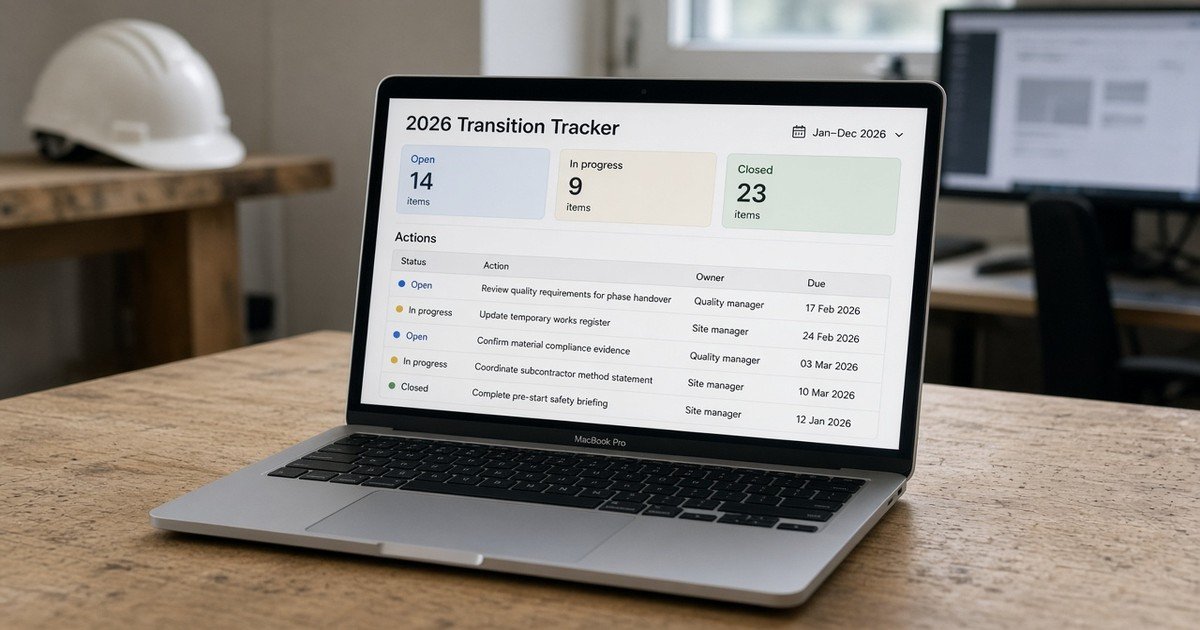
Laptop screen showing a practical ISO 9001:2026 and ISO 14001:2026 transition dashboard with gap status, owners and due dates

Planning your ISO 9001:2026 and ISO 14001:2026 transition does not automatically mean buying a new manual. If you already run an integrated management system around how the work is done, the lean move for a construction or contracting SME in Scotland or elsewhere in the UK is to update what works, add only what is justified, and keep a clear track of the actions.

Accendo is developing a practical dashboard for that ISO 9001:2026 transition. It helps the consultant and the client see existing records, real gaps, owners, due dates, progress, internal audit results and the evidence a certification body visit would sample. AI helps us sort the reading. A consultant reviews the result before any client action is finalised. The dashboard does not certify anyone.

What is an IMS, and why keep the one you already use?

An integrated management system, or IMS, is the single set of procedures, registers, forms and site controls you already use to run quality, environment and, where relevant, health and safety together. For an owner-led construction firm, it should look like how you tender, plan and work on site, not a second company invented on paper.

Replacing your system with a template pack can mean rewriting controls that already work. We start from the system you have. Where does the revised text already match what you do? Where is a small addition enough? Where is there a genuine gap?

We have already set out how we map the 2026 updates against an IMS and produce a gap analysis. This post is about the next step: turning that map into tracked actions.

How does Accendo use AI without handing it the certificate?

We use AI-assisted comparison to help sort clause wording into plain groups: new, changed, moved, editorial or unchanged. The aim is the minimum additions a working IMS may need, not extra procedures. That comparison supports consultant-led checking. It is not a definitive, audited reading of every clause. A consultant checks the official standards and relevant guidance before any client action is treated as final.

The quality themes we are looking at include how risks and opportunities are considered, quality culture and ethical behaviour, follow-through on planned changes, interested parties, and review and audit inputs. The environmental themes include planning of changes, environmental context (including biodiversity and ecosystems where relevant), interested parties, and emergency situations. If you already covered climate change in your context review, that work carries forward.

What does the practical dashboard actually track?

The dashboard is a working view of one client system at a time. It brings together:

  • the records you already keep, such as registers, change logs and review agendas
  • candidate gaps, each with a suggested minimum action, an owner and a due date
  • progress, so open, in progress and closed items are visible
  • internal audit results, kept separate from the certification body visit
  • a simple map of evidence the assessor may want to sample

This is a developing practical approach, not a live automatic feed from client folders or a completed multi-client transition. Some views used while we build the method are illustrations, not finished mappings of real companies. The point is to make the work visible: what to change, who owns it, and when it will be checked.

What does a typical update look like in practice?

This walk-through is hypothetical, not a completed client result.

Imagine a contractor already has a risk and opportunity register and a management review agenda. The comparison flags that risks and opportunities may need to be considered more clearly as separate points, and that planned changes should show who was told, how the change was followed through, and how the result was reviewed. That is a potential gap, not a finished finding.

A consultant then checks the official requirement and the evidence already on file. If the register already does the job, the action may be a clearer column, not a new procedure. If the change log is thin, the minimum justified action might be to extend that log, name an owner and set a due date.

The same pattern can apply to a line in induction on quality culture and ethics, an extra column on an interested parties table, or a check that biodiversity, ecosystem health and emergency situations are considered where they are relevant. Internal audit later samples whether the updates are in use. The dashboard then shows the status and the evidence that would help at a certification body visit. Accendo prepares clients. The certification body certifies.

How Accendo can help

If you want an ISO consultant in Scotland or elsewhere in the UK to track ISO 9001:2026 and ISO 14001:2026 against your existing IMS, without buying a new manual, we can help. Our integrated management system for ISO 9001, 14001 and 45001 is built around how you work, not around paperwork for its own sake. Contact us today at andrew@accendo.org.uk.

Accendo Consultants: lean ISO, UKAS-credible, built for how you work.

ISO Context of the Organisation: One Page for Contractors

Tablet showing a one-page ISO context of the organisation summary for a construction SME, with a review cycle icon and crane

Context of the organisation in ISO 9001, 14001 and 45001 is not a philosophy essay. For a construction SME it is one page: the issues that genuinely affect your business, the people whose needs drive your system, and a note of when you last looked. Capture it once, properly, then refresh it when something real changes. That is what a UKAS assessor needs to see.

As ISO consultants working with UK contractors, we still find clause 4 written as five pages of SWOT and PESTLE copied from a template, rewritten every year, and never read by anyone running a site. It does nothing for the business and very little for the audit. Here is what the standards actually ask for, and a lean way to do it.

What does clause 4 actually require?

Clause 4 sits at the front of ISO 9001, ISO 14001 and ISO 45001 because everything else in your management system hangs off it. In plain English, you need to:

  • Understand your context (4.1). Work out the internal and external issues that affect your ability to deliver what the system is for: quality work, environmental performance, or safe sites.
  • Understand interested parties (4.2). Decide who matters to the system (clients, workers, regulators, neighbours and so on) and what they need from you.
  • Set your scope (4.3). Say what the system covers, and keep that as documented information.
  • Run the system (4.4). Set up, maintain and improve the processes that make it work.

Since the 2024 amendments, ISO 9001, 14001 and 45001 also expect you to decide whether climate change is a relevant issue, and to recognise that interested parties may have climate-related needs. For most contractors that is a sentence or two, not a project.

Notice what is missing. There is no requirement for a SWOT, a PESTLE, a particular template or an annual rewrite. The standards want you to have thought about it and to use the result. How you record it is up to you.

What should a contractor’s context page actually say?

Keep it to the issues that would change a decision. For a typical construction or contracting SME, that might include:

  • Market and clients: reliance on a few principal contractors, frameworks you are bidding for, public sector work that asks for UKAS ISO certificates or SSIP membership.
  • People and competence: labour availability, ageing key staff, card schemes and ticket renewals.
  • Supply chain: material lead times, key subcontractors, plant hire.
  • Legal and regulatory: building safety changes, waste duties, CDM roles, anything new that lands on your sector.
  • Environment and climate: weather disruption on site, client carbon reporting requests, fuel and waste costs.
  • Internal: growth plans, new services, systems you rely on, cash flow pressure.

Six to ten real issues, each with a line on what you are doing about it, beats forty generic ones. Where an issue is a genuine risk or opportunity, it should flow straight into your risk register or objectives. That link is what an assessor follows.

Do we need to rewrite it every year?

No. The standards ask you to monitor and review the issues, not to rewrite the document. The natural place to do that is your management review, which already has to consider changes in external and internal issues. A short minute such as “context reviewed, new framework bid added, labour issue unchanged” is perfectly good evidence.

Update the page itself when something real changes: a new type of work, a big client won or lost, a new regulation, a new office or depot, a move into a different standard. If nothing has changed, say so and move on. An unchanged page with a dated review is far more credible than a freshly rewritten essay that nobody acts on.

What does a UKAS assessor look for?

At Stage 1 and during surveillance, an assessor will usually check that:

  • You can explain your main issues in your own words, not read them off a template.
  • The issues connect to something: risks and opportunities, objectives, the scope, or decisions at management review.
  • Interested parties and their needs are realistic for your business.
  • Context has been reviewed, normally through management review, and kept up to date when the business changed.

The common weak spot is not a missing document. It is a context page that says one thing while the business does another, such as a scope or issues list that ignores a new service line you started last year.

How does this work across an integrated management system?

If you hold ISO 9001, 14001 and 45001 together, you do not need three context documents. One page can cover quality, environmental and health and safety issues, with interested parties tagged by standard where it helps. That is the whole point of an integrated management system for ISO 9001, 14001 and 45001: shared thinking, less paper, one review.

Keep it somewhere live, such as a shared document on SharePoint or OneDrive, so it is easy to update during management review and easy to show on screen at audit.

Where does Accendo fit?

We help construction and contracting SMEs across the UK, and as ISO consultants in Scotland (West Lothian, Edinburgh and Glasgow), get clause 4 right in a short working session: real issues, realistic interested parties, a scope that matches what you do, and links into risks and objectives. Then it is reviewed at management review, not rewritten for the sake of it. Lean, proportionate, and ready for a proper UKAS certification body audit.

Contact us today at andrew@accendo.org.uk.

Accendo Consultants: lean ISO, UKAS-credible, built for how you work.
ISO 9001:2026 and 14001:2026: Mapping Updates to Your IMS

Laptop screen showing an ISO standards gap analysis checklist mapped against an integrated management system dashboard

ISO 9001:2026 and ISO 14001:2026 are both published. For construction and contracting SMEs in the UK, that does not mean a scramble to rewrite everything. It means a clear process: watch what ISO and the certification bodies publish, map the real changes against the system you already run, close the gaps, and leave the rest alone. Here is how Accendo handles that as your ISO consultant.

What has actually changed in the 2026 standards?

ISO 14001:2026 was published on 15 April 2026. ISO 9001:2026 followed on 16 September 2026. UKAS describes the quality revision as targeted updates rather than a fundamental rebuild: clearer wording on interested parties, quality culture and ethical behaviour, risks and opportunities, planning of changes, and management review. The environmental edition follows a similar pattern of clarification and stronger alignment with how environmental issues show up in real operations.

If you already run a lean integrated management system around the work you do on site, you are closer than a sales email suggests. The job is not to invent a second company on paper. It is to show that what you already do still matches the revised text, with a few focused updates where the new editions are clearer.

How does Accendo watch the standards week by week?

Standards and guidance do not arrive as one neat pack. ISO publishes the text. Accreditation bodies such as UKAS issue transition bulletins. Certification bodies then explain how they will assess clients. Waiting for every note to settle before you look at your own system leaves you late. Jumping into a rewrite before the guidance is usable wastes time.

Accendo uses AI agents, with human oversight, to keep a weekly watch on that flow. The agents read the standards text, recent ISO updates and the public news and guidance from certification bodies. They flag what has changed, what is still guidance rather than a hard requirement, and what is relevant to construction and contracting SMEs. A consultant then reviews the output before anything touches a client file. The agents speed the reading. They do not replace judgement, and they do not certify anyone.

How do we map the updates against a client’s IMS?

Once the change list is clear, we map it against the client’s own integrated management system: procedures, registers, forms, site controls and the evidence you already keep. The question is practical. Where does the 2026 text ask for something you already do? Where is the wording sharper than before? Where is there a real gap?

That mapping is client specific. A utilities contractor and a fabricator do not share the same risks, interested parties or site controls. We do not drop a generic template over every IMS. We line the revised clauses up with how that company already works, including ISO 9001, ISO 14001 and, where relevant, ISO 45001 in the same system.

What does the gap analysis and checklist look like?

Where the map shows a gap, we produce a short gap analysis and a simple compliance checklist. Each gap gets a plain description, why it matters for a UKAS accredited assessment, and the smallest practical fix. The checklist is written for the people who run the jobs, not for a filing cabinet.

  • Confirm what already meets the 2026 text so you do not rewrite good controls.
  • List only the real gaps, with an owner and a sensible action.
  • Keep evidence proportionate to how you already work on site and in the yard.
  • Leave room for your certification body’s own transition plan, because assessors will sample what you claim.

Nothing in that pack guarantees a certificate. Accendo prepares clients. The certification body certifies. The point of the checklists is to make the transition lean, visible and ready to sample, not to promise an outcome.

When should you transition?

Certified organisations have a multi year transition window into 2029. For ISO 9001, UKAS expects certification bodies to have all certified customers on the 2026 edition by 30 September 2029. Rushing a rebuild in late 2026 is rarely the lean move. Waiting until the last surveillance of the window is not either. The sensible path is: keep the current UKAS ready system working, watch the official and certification body guidance as it firms up, then close the gaps that your assessor will actually look for.

How Accendo can help

If you want an ISO consultant in Scotland or elsewhere in the UK to map ISO 9001:2026 and ISO 14001:2026 against your IMS, run a gap analysis and hand you simple checklists, we can help. Our integrated management system for ISO 9001, 14001 and 45001 is built around how you work, not around paperwork for its own sake. Contact us today at andrew@accendo.org.uk.

Accendo Consultants: lean ISO, UKAS-credible, built for how you work.

ISO Quality Objectives: Examples for Construction SMEs

Laptop dashboard showing one-page ISO objectives for a construction company with progress bars and a target icon

ISO 9001 quality objectives for a construction SME should fit on one page. Three to six measurable targets, tied to the things that already cost you money (late handovers, rework, snags, waste, accidents), each with an owner and a date, reviewed at management review. That is the requirement. The forty-line corporate scorecard that nobody opens between audits is not.

As ISO consultants working with UK contractors, we still see objectives written as wallpaper: “to continually improve customer satisfaction”, “to be the contractor of choice”, “to protect the environment”. They sound fine on a policy board and give a UKAS assessor nothing to sample. Here is what the standards actually ask for, and some examples that work on real sites.

What does ISO 9001 actually require for quality objectives?

The requirement sits in clause 6.2 of ISO 9001:2015, quality objectives and planning to achieve them. In plain English, your objectives must:

  • Be consistent with your quality policy and relevant to your services and to keeping customers happy.
  • Be measurable, so you can tell whether you hit them.
  • Be monitored, communicated and updated as things change.
  • Come with a plan: what will be done, what resources are needed, who is responsible, when it will be finished and how the results will be evaluated.
  • Be kept as documented information. A short table is enough.

Notice what is not there. No minimum number, no set format, no requirement for a balanced scorecard or a KPI for every department. ISO 14001 (environmental objectives, clause 6.2) and ISO 45001 (OH&S objectives, clause 6.2) follow the same pattern, so an integrated management system can hold all of them in the same one-page table.

What are good examples of ISO objectives for a contractor?

The best objectives use numbers you already collect for running the business. A few examples we see work well for construction and contracting SMEs:

  • Quality (ISO 9001): hand over 90% of projects on or before the agreed completion date; reduce snags at handover to an average of no more than a set number per job; keep rework costs below an agreed share of turnover; close customer complaints within 10 working days.
  • Environmental (ISO 14001): increase the share of skip waste segregated or recycled; cut fuel used per vehicle by a set percentage through route planning and idling rules; zero environmental incidents reported by clients or regulators.
  • Health and safety (ISO 45001): 100% of operatives inducted before starting on site; deliver a toolbox talk on every live site every fortnight; close site inspection actions within an agreed number of days; no RIDDOR reportable incidents.

Set the actual targets from your own data. If you do not yet know your snag rate or recycling rate, the first objective can simply be to start measuring it consistently, with a target set at the next management review. That is honest, and assessors accept it.

How many objectives do you need?

Fewer than you think. For a typical SME, three to six objectives per standard is plenty, and often fewer for a small team. If an objective has no owner, no number and no action plan, it is not helping you and it gives an assessor an easy finding. Better to have four you genuinely track than fifteen you copy forward every year.

What does a UKAS assessor check on objectives?

At Stage 1, Stage 2 and surveillance audits, a UKAS accredited certification body will usually check that:

  • Objectives exist for relevant functions and levels, and link back to the policy.
  • They are measurable, and you can show current results against them.
  • Someone owns each one, and there is a plan with timescales.
  • Results were reviewed at management review, with decisions recorded (keep, raise the target, change the approach).
  • People in the business know the objectives that affect their work. A site supervisor who can tell the assessor about the snag target is worth more than a laminated poster.

The common nonconformities are predictable: objectives that are not measurable, no evidence of monitoring during the year, or objectives that have not changed in three years with no explanation.

How do you keep objectives on one page?

A lean set-up that works for most contractors:

  • One table with columns for objective, standard, target, measure, owner, actions, due date and latest result.
  • Results pulled from data you already hold: programme dates, snag lists, waste transfer notes, fuel cards, inspection reports.
  • A quarterly glance at a simple dashboard or spreadsheet, so the management review is a short decision meeting rather than a hunt for figures.
  • Last year’s objectives carried forward with the same measurement method, so you can compare like with like, then adjusted where the business has moved on.

That covers clause 6.2 across ISO 9001, 14001 and 45001, survives an audit sample and takes minutes a month to keep up.

How Accendo can help

If your objectives read like a mission statement, or you are not sure what your UKAS assessor will expect to see, we can help you turn them into a short set of targets your team can actually use. We are ISO consultants in the UK working with construction and contracting SMEs, including clients across Scotland in Edinburgh, Glasgow and West Lothian, on ISO 9001, ISO 14001 and ISO 45001. Our integrated management system for ISO 9001, 14001 and 45001 keeps objectives and every other control proportionate to the work you actually do. Get in touch for a friendly, no pressure chat.

Accendo Consultants: lean ISO, UKAS-credible, built for how you work.
https://accendo.org.uk/

Pre-Assessment Site Audit: MCL Ready for ISO Assessment

Tablet showing a completed site audit checklist beside a green shield with a tick and an orange hard hat

I have just been on site at MCL carrying out a pre-assessment site audit. The result: MCL is compliant and ready for its ISO assessment next week. Here is why that visit matters, and why I recommend one to every client before an external assessor turns up.

What is a pre-assessment site audit?

A pre-assessment site audit is a final, practical check of how the management system works in real life, done shortly before the certification body visits. It is not a rerun of the internal audit and it is not a paperwork exercise. The question is simple: if an assessor walked in tomorrow, would what they see match what the system says?

MCL works in the utilities and civil engineering sector, so the real work happens out on site and in the yard, not at a desk. That is exactly why the audit had to happen there.

Why does it matter before an ISO assessment?

As an ISO consultant working with UK contractors, I see the same pattern again and again. A company has good procedures and tidy records, but nobody has checked that the two line up with daily practice. Assessors find that gap in minutes.

A site audit a week or so before the assessment gives you three things:

  • Confidence. You know where you stand, rather than hoping.
  • Time to fix. Anything small can be tidied up before the assessor arrives, not explained away afterwards.
  • Better answers. Staff who have just been asked the questions are far more relaxed when the assessor asks them again.

What did I check on site?

I kept it practical and in line with the integrated management system covering quality, environment, and health and safety. In general terms, a visit like this looks at:

  • Do people know the system? Do staff understand the policy, their own responsibilities and where to find the information they need?
  • Are the records live? Checks, inspections and forms completed, current and consistent with what is happening on the ground.
  • Is the site in good order? Housekeeping, equipment, controls and signage that match the risks and the procedures.
  • Do the processes work as written? What the procedures say against what actually gets done.
  • Is the paperwork joined up? Internal audit, management review and corrective actions all telling the same story.

Across everything I looked at, the system and the site matched. MCL is in a good position and ready for assessment.

Does that mean certification is guaranteed?

No, and anyone who promises that is selling you something. The certification body makes the decision, and it should. What a pre-assessment site audit does is make sure you walk into that assessment prepared, with a management system that reflects how you really work. Ready for assessment is the goal, and for MCL we are there.

Is a pre-assessment audit worth it for a small contractor?

Yes. For a small or mid-sized business, the assessment is a big day. A short, focused site visit costs far less than the stress of a surprise finding, and it keeps the system lean. If a record or procedure adds nothing, it should go, not grow. That is how ISO should be done: quicker and lighter than most people expect, and still credible with UKAS-accredited certification bodies.

Looking for an ISO consultant in Scotland or across the UK?

We are an ISO consultant based in West Lothian, working with contractors and SMEs across Scotland, including Edinburgh, Glasgow and the central belt, and across the UK. If you have an ISO 9001, ISO 14001 or ISO 45001 assessment coming up and want someone to check it works on site before the assessor does, take a look at our integrated management system for ISO 9001, 14001 and 45001, or just ask for a chat. Contact us today at andrew@accendo.org.uk.

Accendo Consultants: lean ISO, UKAS-credible, built for how you work.