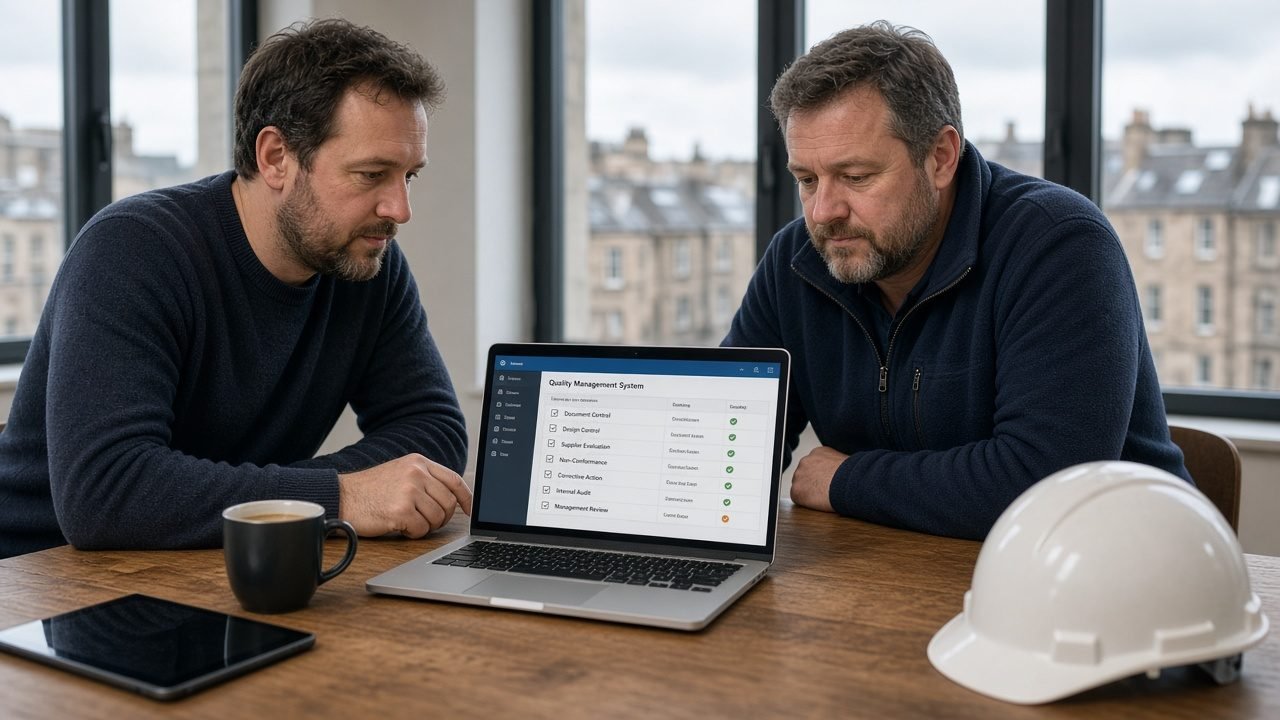
Choosing an ISO 9001 consultant in Scotland is mostly about one question: will this person help you build a quality system that fits how your business already works, and get you through a UKAS-accredited assessment without burying you in paperwork? For owner-led contractors and engineering firms in Edinburgh, Glasgow, West Lothian and across the central belt, the right consultant saves time. The wrong one leaves you with a thick manual nobody reads.
This guide is for business owners and office managers who have been asked for ISO 9001 by a client, a framework or a tender, and are now comparing consultants. Here are the questions worth asking on that first call.
Will the system be built around how we work?
A good ISO 9001 consultant starts by asking how you win work, plan jobs, buy materials, check quality and deal with problems. The system should describe and tidy up what you already do. If the first thing on offer is a generic pack of documents with your logo added, expect a system that does not match your business, and an assessor who notices.
Is the certificate UKAS-accredited, and who issues it?
Consultants prepare you. A certification body assesses you and issues the certificate. Ask which certification bodies the consultant works alongside and whether they are UKAS-accredited. Many main contractors, councils and framework buyers check for UKAS, so a cheaper non-accredited certificate can cost you work later. We explain the difference in UKAS vs non-UKAS certificates: what tender buyers actually check.
What will we have to do ourselves?
No consultant can run your quality system for you. Records have to come from real jobs, and the certification body will talk to your people. Ask the consultant to be clear about the split: what they write, what you provide, and how much of your time it needs each month. A clear answer at the start avoids surprises before Stage 2.
How do you handle the internal audit and management review?
Both are required before the Stage 2 assessment. Ask who carries out the internal audit, how evidence is collected, and how the management review is run. A practical approach keeps these short and focused on the things that matter: customer feedback, problems and corrective actions, objectives, suppliers and resources.
Can it grow into ISO 14001 and ISO 45001 later?
Many construction SMEs start with ISO 9001, then add ISO 14001 or ISO 45001 when clients or SSIP schemes ask. Ask whether the system can become one integrated management system, sharing document control, audits, management review and corrective action, rather than three separate manuals. That choice up front makes the next standard much quicker to add.
What happens after the certificate?
Certification is not a one-off. There are surveillance visits each year and a recertification every three years. Ask what support looks like after the first certificate, how findings are closed, and how the system is kept lean as the business changes.
Red flags to watch for
- Guaranteed certificates. Only an independent certification body can decide that.
- Huge document packs. More paper does not mean a better system.
- No mention of UKAS. If accreditation never comes up, ask why.
- Vague timelines. A consultant should help you work back from the date you need the certificate.
- No questions about your work. If they do not ask how your jobs run, they cannot build a system that fits.
Working with Accendo
We are an ISO consultancy based in Armadale, West Lothian, supporting construction, engineering and manufacturing SMEs across Scotland and the UK. Our Lean IMS for ISO 9001, 14001 and 45001 builds one practical integrated management system around the way your business already runs, ready for a UKAS-accredited assessment.
Contact us today at andrew@accendo.org.uk.
Accendo Consultants: lean ISO, UKAS-credible, built for how you work.