
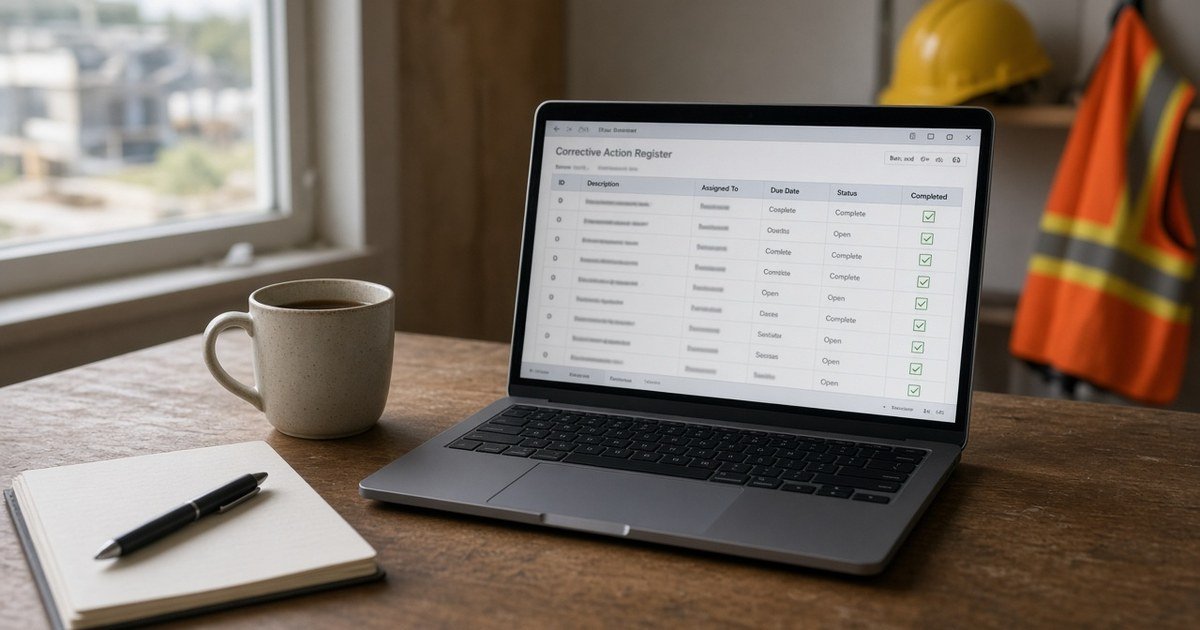
ISO corrective actions should be closed while the job is still fresh, not in the week before the auditor returns. An open list that has sat still since Stage 2, or since last year’s internal audit, is one of the first things a UKAS assessor will notice on a surveillance visit.
This is practical advice for construction and contracting SMEs in the UK, including owner-led firms in Scotland, who want a lean way to close findings properly before the next certification body visit.
Why do open actions matter at the next visit?
Surveillance is not a rerun of Stage 2, but it does check whether the system is still being used. Assessors typically look at progress on previous findings, and at how you handle new problems that have come up since: complaints, incidents, nonconformities and improvement actions. Our article on what surveillance actually checks covers the wider sample. The corrective action register is often the shortest route into that conversation.
If actions are still open with no owner, no date and no evidence of work, the assessor will reasonably ask whether the system is running. A short, honest register that shows what was raised, who owns it, and what changed is much stronger than a long list that never moves.
What does “closed” actually mean?
Closing an ISO corrective action is more than marking a row complete. For each finding, you should be able to show:
- What was found, in plain language, and where.
- The cause, at a useful level, not a one-word label such as “human error”.
- What you changed, which might be a record, a briefing, a control on the next jobs, or, if the same gap kept appearing, a change to the way of working.
- Evidence that the fix was done, and a simple check that it has stuck.
- An owner and the dates you raised and closed it.
The certification body sets the timescales for findings they raised. Treat major nonconformities as urgent. Minors still need a proper cause, fix and check. A promise to look at it later is not closure.
Keep the response proportionate. A missing induction record on one site may need the record completed, a reminder to the supervisor, and a check on the next few jobs. It does not automatically need a rewritten procedure. The same gap on several sites might.
How do you keep a register people will actually use?
You do not need new software. The register you already have is enough if it is short, current and used. One list for certification body findings, internal audit actions, incidents and complaints is usually better than four spreadsheets nobody opens.
Review open actions in a meeting the business already has, such as an operations or directors’ meeting, not only in the quality folder. Name an owner who can actually do the work. Give a realistic date. If a date slips, record why and set a new one. Silent slippage is what assessors notice.
Do not raise actions you have no intention of closing. A long list of vague improvements makes the system look busy and then becomes a problem in its own right at the next visit.
What evidence should you keep?
File evidence that the gap is fixed, not only a completed form. A revised risk assessment, a completed training record, a job pack from the next site, or a dated register entry with an owner is more convincing than a paragraph of intent.
Keep it with the action, or in a place you can find quickly when the assessor asks. You should be able to talk through a closed item in a few sentences: what was wrong, what you did, and how you know it has not come back.
What if something cannot be fully closed yet?
Some actions take longer because they depend on a later job, a supplier, or a seasonal activity. That is fine if the register shows a real plan, progress so far, and a reason the item is still open. It is not fine if the row has sat untouched since the last visit.
If the same issue keeps returning, do not keep closing it as a one-off. Take it to management review and decide whether the control itself needs to change. Recurring findings are one of the clearest signals that the system is not doing its job.
Where does Accendo fit?
We help construction and contracting SMEs across the UK, and as ISO consultants in Scotland (West Lothian, Edinburgh and Glasgow), keep corrective actions lean and closeable, so the next UKAS visit is a check on a working system, not a scramble through last year’s list. That is the same thinking behind our integrated management system for ISO 9001, 14001 and 45001.
Contact us today at andrew@accendo.org.uk.
Accendo Consultants: lean ISO, UKAS-credible, built for how you work.