
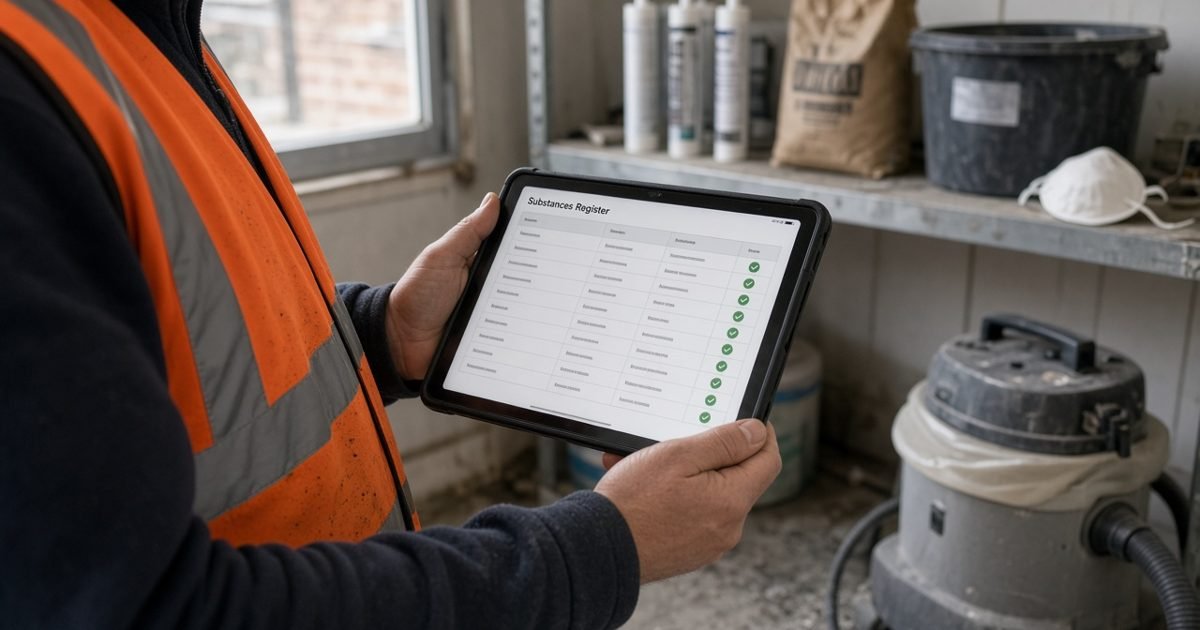
The COSHH records an ISO 45001 contractor actually needs are fewer than most binders suggest: a list of the substances you really use, a short assessment for each one or each task, the controls that go with it, and proof those controls are checked and briefed on site. For construction SMEs, that is the core of what a UKAS assessor will sample, and it is also what the law already asks of you.
This is practical advice for UK contractors and owner-led firms, including those working towards ISO 45001 in Scotland, who want COSHH to work on live jobs rather than sit in a cupboard.
What does ISO 45001 expect for COSHH?
ISO 45001 does not have a COSHH clause. It asks you to identify hazards, assess the risks, know your legal requirements, put controls in place and check they work. For hazardous substances in Great Britain, the legal requirement behind that is the Control of Substances Hazardous to Health Regulations 2002 (COSHH). So the ISO 45001 question is simple: can you show you meet COSHH on the work you actually do?
That means the assessor is less interested in how thick the COSHH file is and more interested in whether the assessment on file matches the product in the van, and whether the operative using it knows the controls.
Which COSHH records do construction SMEs actually need?
For most contractors, a lean and defensible set looks like this:
- A substances list. One register of the products and processes you use, with the supplier, where it is used and a link to the current safety data sheet. Keep it to what is really on site and in the yard.
- COSHH assessments. A short assessment for each substance or, often better, for each task. If you employ five or more people, the significant findings must be recorded.
- Process-generated hazards. Dust and fume made by the work, such as silica dust from cutting, drilling or chasing, wood dust and welding or diesel fume. These have no safety data sheet, so they are the ones most often missed.
- Control measures. On-tool extraction, water suppression, ventilation, substitution of a less harmful product, and the right RPE, gloves and eye protection for the task.
- Checks on the controls. Local exhaust ventilation (LEV) must have a thorough examination and test at least every 14 months. Face-fit testing for tight-fitting RPE. Simple pre-use checks for extraction and masks.
- Health surveillance, where it applies. For example, skin checks for regular cement or resin work, or lung function checks where there is significant exposure to certain dusts. Where health surveillance is required, the records must be kept for at least 40 years.
- Information, instruction and training. A toolbox talk or RAMS briefing that covers the substance and its controls, with a record of who attended.
That is it for most firms. You do not need a separate 20-page assessment for every tin of paint or a copy of every safety data sheet printed and filed.
Is a safety data sheet the same as a COSHH assessment?
No. This is the most common gap we see. A safety data sheet tells you about the product. A COSHH assessment tells you how your people use it, how much, for how long, where, and what controls you put in place. An assessor will usually ask to see both, and will check that the assessment reflects how the task is really done.
Keep safety data sheets current and easy to find, ideally linked from your substances list in the system you already use. Then write the assessment around the task.
How do you keep COSHH records lean but credible?
- Assess by task where you can. One assessment for cutting and chasing masonry covers several products and the dust they make. It is easier to brief and easier to keep up to date.
- Put the controls in the job pack. If the RAMS for a job do not mention the extraction, RPE or welfare needed for the substances on that job, the assessment is not doing its work.
- Review on change. New product, new supplier, new task, an incident or ill-health report. Also review on a set cycle in the same register you use for other risk assessments.
- Clear out what you no longer use. Old products on the list make the register look unmanaged and waste everyone’s time.
- Give each record an owner. Someone who can explain the controls and show the latest check.
What will a UKAS assessor sample on site?
Expect the assessor to pick a live task, often cutting, drilling, painting, sealing or cleaning, and follow it through. They may ask which products are in use, then look for the assessment, the safety data sheet, the controls on the job, the RPE and its face-fit record, the LEV test date on any extraction, and the briefing record for the people doing the work. They will also check that COSHH sits in your legal register and hazard identification, not in a separate folder no one opens.
If the record and the site match, it is a short conversation. If they do not, it is usually a finding, even when there is a lot of paperwork.
Where does Accendo fit?
We help construction and contracting SMEs across the UK, and as ISO 45001 consultants in Scotland (West Lothian, Edinburgh and Glasgow), set up COSHH records that match the work and stand up at a UKAS-accredited assessment. If you are adding health and safety to a quality or environmental system, see our guide to adding ISO 45001 to an existing 9001 or 14001 system, or our integrated management system for ISO 9001, 14001 and 45001.
Contact us today at andrew@accendo.org.uk.
Accendo Consultants: lean ISO, UKAS-credible, built for how you work.