
Ask a room of construction SME owners what ISO 9001 says about calibration and most will tell you the same thing: every tool with a serial number needs a certificate, every year, or the auditor will raise a nonconformity. It is one of the most expensive bits of ISO folklore going, and it is not what the standard says.
As ISO consultants working with UK contractors, we regularly find calibration registers listing tape measures, spirit levels, drills and even kettles. The standard asks a much simpler question: where do your measurements actually matter, and can you trust them there?
What does ISO 9001 actually require for calibration?
The requirement sits in clause 7.1.5 of ISO 9001:2015, monitoring and measuring resources. In plain English it asks for three things:
- Fit for purpose. Where you use monitoring or measuring to verify that your work meets requirements, the equipment has to be suitable for the job and maintained so it stays suitable. You keep evidence of that.
- Traceability only where it is needed. Calibration or verification against traceable national or international standards is required when measurement traceability is a requirement (for example, a client specification or regulation demands it), or when you decide it is an essential part of giving confidence in your results.
- Know the status, protect it, act on problems. Calibrated kit must be identifiable as such, protected from damage or adjustment that would spoil the result, and if it is found to be out, you check whether earlier results were affected and act on it.
Notice what is not there. There is no list of tools, no annual frequency and no demand for a certificate on everything. The trigger is the measurement and the risk, not the asset register. ISO 14001 and ISO 45001 take the same approach in their monitoring and measurement clauses: calibrated or verified equipment is used and maintained as appropriate.
Which construction tools usually need calibration?
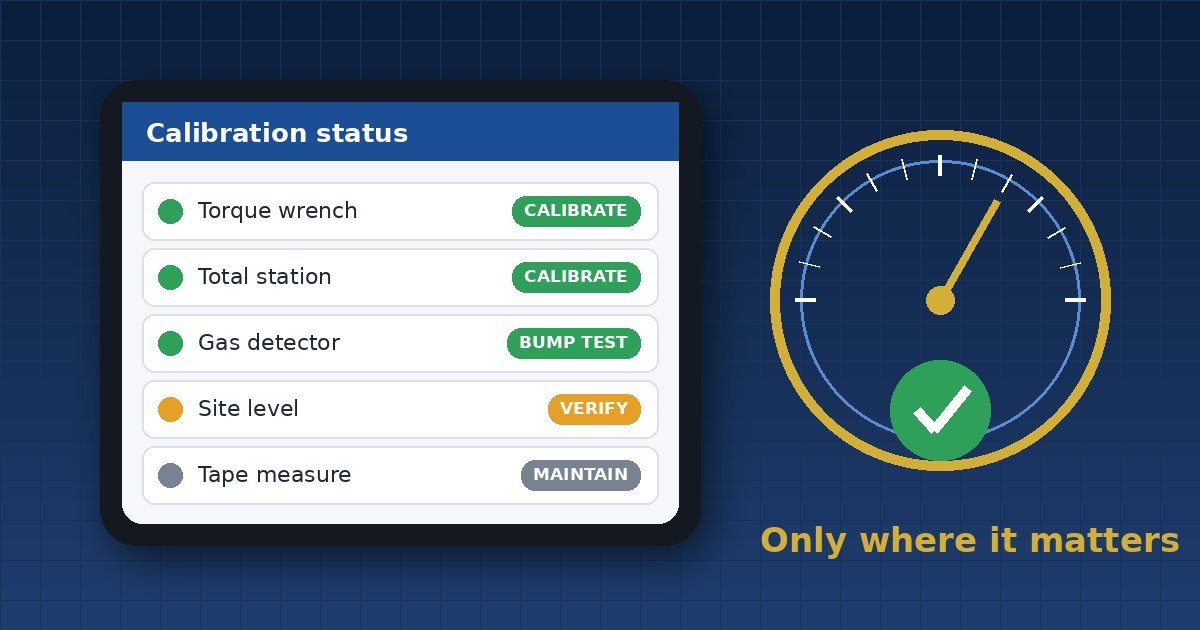
Start from the measurement, not the toolbox. If a reading is used to accept work, prove compliance or protect people, it probably belongs in your calibration or verification arrangements. Typical examples for contractors include:
- Torque wrenches where bolt tightening is specified, such as steel connections or anchor fixings with a stated torque.
- Total stations, lasers and levels used for setting out or as-built surveys, usually through a manufacturer or service centre calibration plus simple field checks between services.
- Gas detectors used for confined space entry, which typically need regular bump tests and periodic calibration in line with the manufacturer’s instructions.
- Test instruments used to certify electrical installations, where the reading goes straight onto a certificate the client relies on.
- Noise or vibration meters if you use them to make decisions about exposure.
Where the testing is outsourced, for example concrete cubes or soil compaction tests sent to a laboratory, the simplest control is to choose a UKAS accredited lab for those tests and keep the results. You do not need to calibrate their equipment for them.
Which tools do not need a calibration certificate?
Plenty of measuring kit on site is used for guidance rather than acceptance. A tape measure used to mark out a stud wall, a spirit level on a fence line or a cheap moisture meter used to decide whether to come back tomorrow rarely needs traceable calibration. Good condition and a sensible check are enough.
A proportionate approach looks like this:
- Calibrate kit where the reading accepts work, appears on a certificate or protects people.
- Verify kit where accuracy matters but a simple check will do, such as comparing tapes against a reference tape or running a two peg test on a level.
- Just maintain everything else and replace it when it is damaged.
Write that decision down once in your integrated management system, so the auditor can see the thinking. That is far more convincing than a register full of tools nobody can explain.
What do UKAS assessors actually check?
At a UKAS accredited assessment the auditor will usually sample a real job and follow the measurement trail. Expect questions like these:
- Which measurements prove this work met the specification?
- What equipment took them, and how do you know it was accurate on the day?
- How can a site operative tell the instrument is in date?
- What happened the last time a piece of kit failed a check or was dropped?
The last question catches people out. If a torque wrench comes back from calibration reading low, ISO 9001 expects you to consider whether the work it was used on is still acceptable. A short note of what you checked and decided is normally all that is needed, but it needs to exist.
How to keep calibration records lean
You do not need a dedicated spreadsheet that one person updates once a year. A lean setup for a construction SME usually means:
- A short list of the instruments that genuinely need calibration or verification, with an owner and a due date.
- Calibration certificates saved as PDFs in one shared folder, named by asset and date, so anyone can find them from site.
- A sticker or tag on each instrument showing its status and next due date.
- A calendar reminder or digital form for verification checks, with a photo of the check rather than a paper sheet.
- One line in your nonconformity log when kit is found out of tolerance, plus what you did about earlier work.
That covers the requirement, survives an audit sample and takes minutes a month to keep up.
How Accendo can help
If your calibration register has grown into an asset list, or you are not sure what your UKAS assessor will expect to see, we can help you strip it back to what matters. We are ISO consultants in the UK working with construction and contracting SMEs, including clients across Scotland in Edinburgh, Glasgow and West Lothian, on ISO 9001, ISO 14001 and ISO 45001. Our integrated management system for ISO 9001, 14001 and 45001 keeps calibration and every other control proportionate to the work you actually do. Get in touch for a friendly, no pressure chat.
Accendo Consultants: lean ISO, UKAS-credible, built for how you work.