After the Certificate: What Surveillance Actually Checks

Getting the certificate feels like a finish line. For a UKAS-accredited certification body, it is the start of a maintenance relationship. Surveillance visits sample whether your system still runs. Understanding what they check helps you keep certification without sliding back into bureaucracy.

Certification is not a one-off product

After Stage 2, you typically enter a cycle of surveillance audits, then recertification. The body is not re-doing your entire Stage 2 every year, but it is not a courtesy visit either. Assessors sample processes, sites, and records to confirm ongoing conformity and effectiveness.

If the system only existed for assessment week, surveillance is where that becomes obvious.

What surveillance usually samples

Exact plans vary by body, standard, and risk, but construction and contracting SMEs should expect sampling around:

  • Continued operational control on live or recent work
  • Competence and awareness for people in controlled roles
  • Internal audit and management review happening as planned, with real outputs
  • Handling of complaints, incidents, nonconformities, and improvement actions
  • Changes since last visit: scope, organisation, sites, key processes
  • Documented information still controlled (current versions in use)
  • Progress on previous findings

They follow evidence. They talk to people. They notice when the system has gone quiet.

Maintenance without a paperwork factory

The goal after certification is not to invent more forms so surveillance looks busy. The goal is to keep the lean system alive:

  • Run the controls that protect delivery and compliance
  • Keep internal audit as a useful sample, not a clause marathon
  • Use management review to make decisions with current data
  • Close actions properly when something goes wrong
  • Update procedures when practice changes, not once a year as a ritual

That is enough for most SMEs. Extra binders do not impress surveillance assessors if the lived controls are weak.

Common ways certificates get into trouble

Surveillance findings often appear when:

  • Key people left and nobody owns the system
  • Sites multiplied and control did not follow
  • Internal audits stopped or became tick-box theatre
  • Records for competence or operational checks drifted
  • Scope drifted away from what you actually do

None of those require a heavy new manual to fix. They require ownership and a light, regular rhythm.

Accendo’s view of life after the certificate

Accendo Consultants builds systems meant to survive contact with real work, including surveillance. We prepare SMEs for UKAS-credible certification and help keep maintenance proportionate so the certificate remains an asset for tenders, not a seasonal panic.

Lean ISO is not only for Stage 1 and Stage 2. It is how you stay certified without hiring a full-time paperwork department.

Keeping surveillance boring (in a good way)

Boring surveillance is a compliment: few surprises, clear evidence, open discussion of changes. If you want a sense-check on whether your post-certificate rhythm is still lean and credible, we are happy to help you tighten what matters and drop what does not.

Accendo Consultants: lean ISO, UKAS-credible, built for how you work.
https://accendo.org.uk/
Scope Is Not a Slogan: Getting Stage 1 Scope Right First Time

Scope is one of the first things a Stage 1 assessor reads, and one of the easiest places for SMEs to trip. A vague slogan on a certificate application (“quality construction services nationwide”) looks impressive in a brochure and weak under assessment. Getting scope right first time saves delay, cost, and awkward rework before Stage 2.

What scope actually has to do

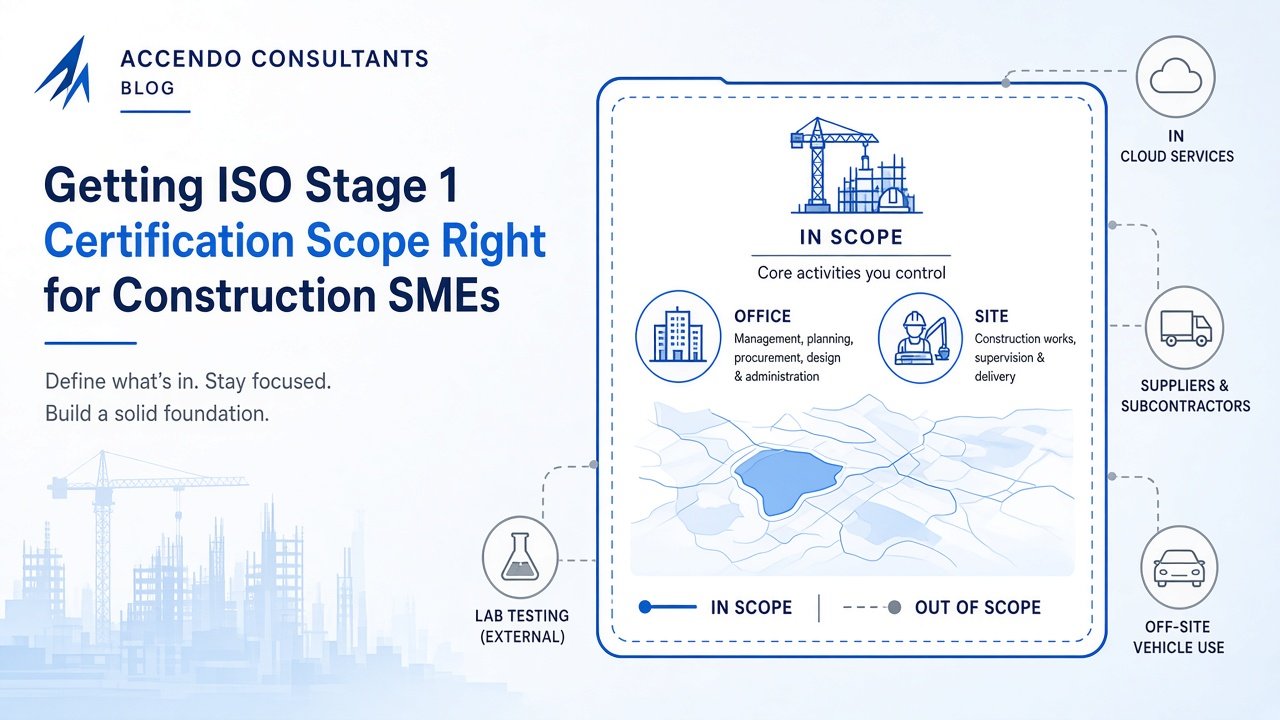
Scope defines what is covered by your management system and certificate: activities, products or services, and locations where relevant. It should be clear enough that an outsider can tell what is in and what is out.

It is not a marketing line. It is a boundary. If the boundary is fuzzy, assessment planning, sampling, and the finished certificate all suffer.

Clear in and clear out

Good scope statements for construction and contracting SMEs usually:

  • Name the services you actually deliver under the system (for example design and build, M&E, civil works, maintenance, facilities)
  • Reflect the standards you are claiming (9001, 14001, 45001, or integrated)
  • Make exclusions explicit where the standard allows them, with a reason that holds up
  • Avoid empty adjectives that add prestige and remove meaning

If a buyer or assessor cannot tell whether a given contract sits inside the certificate, the scope is not finished.

Multi-site and construction reality

Many SMEs run from a head office with temporary sites, satellite yards, or regional teams. Scope and the supporting description need to match that reality: which sites are permanent, how temporary sites are controlled, and whether remote or multi-site arrangements affect certification.

Wrong assumptions here cause Stage 1 findings and can push Stage 2 out. Assessors need a credible picture of where the system operates so they can sample it.

Why wrong scope delays Stage 2

If Stage 1 finds that the documented system does not cover the claimed scope, or that the scope claims work you cannot evidence, the certification body will not pretend otherwise. You fix the scope and the system alignment, then Stage 2 proceeds.

That delay is avoidable. It is usually cheaper to define a proportionate scope up front than to expand paperwork to defend a slogan.

Proportionate beats impressive

There is no prize for the widest possible scope on day one. A tight, honest scope that matches how you win and deliver work is stronger than a broad claim you cannot support. You can extend later when the system is lived and the evidence is there.

Accendo Consultants helps SMEs define proportionate, UKAS-credible scope as part of Stage 1 readiness. We translate how you actually operate into wording and system boundaries that assessors and tender buyers can both understand.

Getting scope right before Stage 1

If you are drafting or rewriting scope for ISO 9001, 14001, or 45001, treat it as a design decision, not a tagline. Map activities, locations, and exclusions. Check that your processes and records can support every word.

If you want a second pair of eyes before you lock it in with a certification body, talk to Accendo. We will help you keep it lean, clear, and defensible.

Accendo Consultants: lean ISO, UKAS-credible, built for how you work.
https://accendo.org.uk/
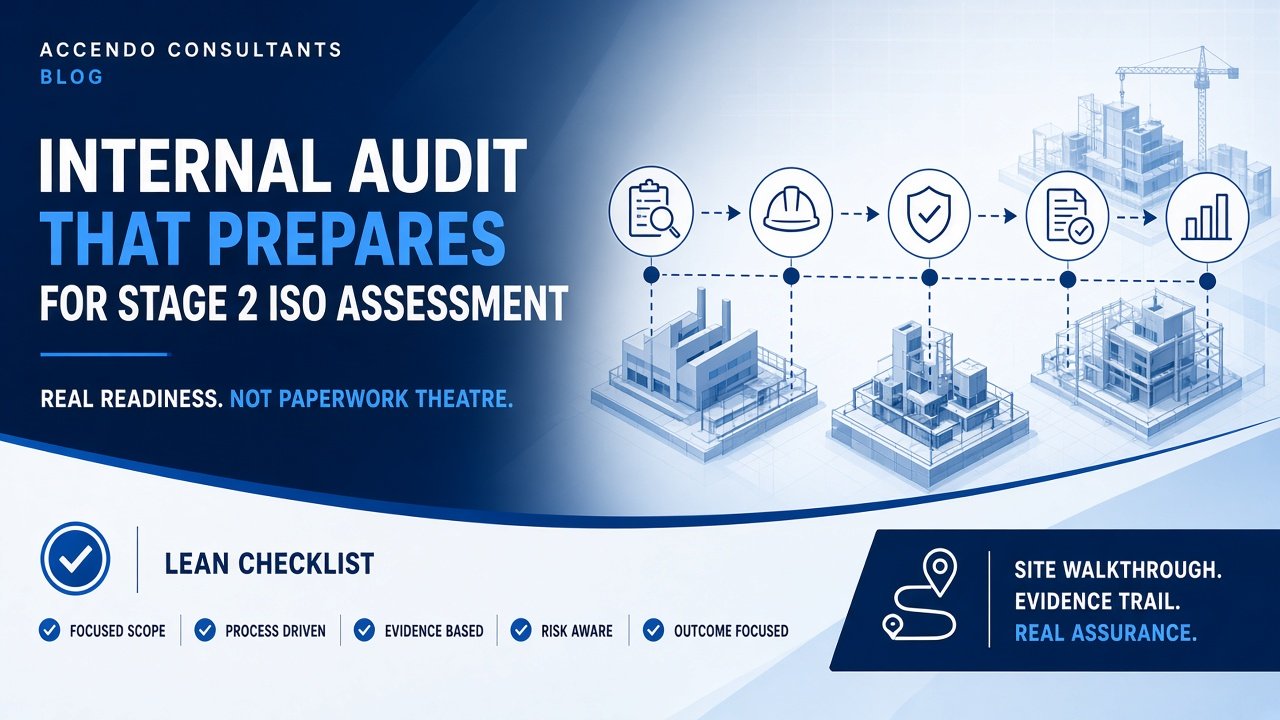
Your Internal Audit Should Prepare You for Stage 2, Not Create Another Manual

Internal audit is one of the most misused parts of an SME ISO system. Done badly, it becomes a second quality manual: clause-by-clause checklists, endless soft findings, and a report nobody reads. Done well, it is a short, sharp sample of real work that makes Stage 2 less of a surprise.

What internal audit is for

The point is not to prove you audited every sentence of the standard. The point is to check whether your system is working where it matters, find useful gaps, and fix them before an external assessor does.

For construction and contracting SMEs, that usually means following jobs, sites, and support processes that actually run: estimating to handover, health and safety controls on site, environmental aspects where they apply, supplier and subcontractor control, competence, and how you handle problems when they appear.

Sample real work, do not invent a parallel universe

A useful audit looks at:

  • A live or recently completed job pack and whether controls ran as described
  • Conversations with the people who do the work, not only the person who wrote the procedure
  • Records that the work naturally produces (not a special audit folder filled the week before)
  • Open actions from previous audits, incidents, or complaints, and whether they closed properly

If your audit only reviews documents in the office and never touches delivery, Stage 2 will feel like a different exam.

Useful findings beat perfect scores

Assessors are not impressed by an internal audit that finds nothing year after year while the business clearly has friction. A small number of clear nonconformities or improvements, with owners, dates, and evidence of closure, shows the system is honest.

Theatre findings (“consider reviewing the procedure for clarity”) that never change anything waste everyone’s time. Raise what matters. Close what you raise.

Do not build a second QMS for the auditors

You do not need a separate audit empire, a hundred-page checklist, or a consultant voice that nobody in the business can repeat. Keep the programme proportionate:

  • Plan coverage across the year so important processes get sampled
  • Use checklists as prompts, not as a script that replaces judgement
  • Record enough evidence that someone else can follow what you looked at
  • Feed results into management review so leadership actually decides something

That is lean internal audit. It still meets the standard. It also prepares people for the questions a Stage 2 assessor will ask.

How this feeds Stage 2 readiness

Stage 2 samples implementation and effectiveness. If your internal audits have already walked the same trails, your team will be calmer, your evidence will be easier to find, and awkward gaps will already be closed or knowingly managed.

If your internal audits are decorative, Stage 2 becomes the first real test. That is an expensive way to learn.

Making audit useful without the weight

Accendo Consultants helps SMEs run lean internal audits that match delivery and still look credible to UKAS-accredited certification bodies. We are interested in readiness, not in creating another manual that only exists for audit day.

If your current audits feel like paperwork for paperwork’s sake, we can help you redesign them around sampling, useful findings, and Stage 2 confidence.

Accendo Consultants: lean ISO, UKAS-credible, built for how you work.
https://accendo.org.uk/
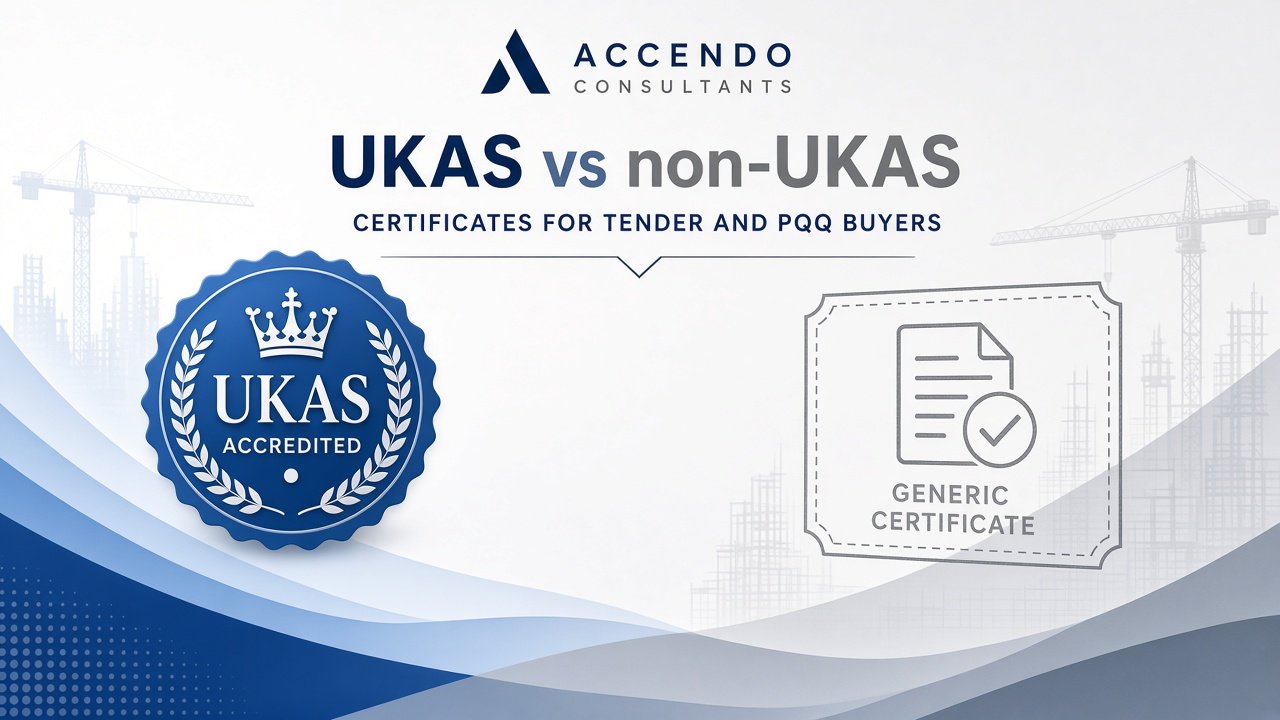
UKAS vs Non-UKAS Certificates: What Tender Buyers Actually Check

When a tender or PQQ asks for ISO certification, buyers are not collecting logos. They are managing supply-chain risk. Understanding what they actually check helps you choose the right path and avoid a cheap certificate that fails at the gate.

The UKAS crown is the shortcut buyers trust

UKAS is the United Kingdom’s national accreditation body. A certificate issued by a UKAS-accredited certification body carries a recognisable mark of accreditation. Many public sector and main contractor PQQs treat that mark as the difference between accepted and queried.

Buyers are busy. They are not going to reverse-engineer every certification scheme on earth. UKAS gives them a clear, defensible line: accredited body, accredited scope, certificate that can be verified.

Questions buyers and evaluators often ask

In practice, tender teams and compliance reviewers tend to look for:

  • Is the certification body UKAS-accredited (or equivalently recognised under IAF MLA arrangements where that is specified)?
  • Does the certificate scope cover the work you are bidding for?
  • Is the certificate current, and is surveillance up to date?
  • Can the certificate be verified (certificate number, body name, searchable register)?
  • Does the standard match the PQQ (ISO 9001, 14001, 45001, or a combination)?

If any of those answers are fuzzy, you create work for the buyer. Busy buyers often park fuzzy bids.

Why cheaper or faster non-UKAS routes look tempting

Non-UKAS certificates are often sold as quicker and cheaper. For some private buyers who never check, they may never bite. For anyone running a serious PQQ, they can become a problem at the worst moment: after you have priced the job and committed resource.

Risks include:

  • Automatic fail on “UKAS-accredited certification required”
  • Clarification requests that burn time and raise doubt
  • Main contractors who accept your bid then get pulled up by their own client
  • Re-work later when you discover you still need a UKAS path for the frameworks that matter

Speed without acceptance is not speed. It is delay deferred.

Scope and credibility matter as much as the logo

Even with UKAS, a narrow or vague scope can sink you. If your certificate says something your delivery does not match, buyers notice. So do assessors. Getting scope right at Stage 1, and keeping the system proportionate to that scope, is part of looking credible on paper and on site.

Accendo prepares you for the UKAS path

Accendo Consultants does not sell certificates. We build lean management systems that stand up to UKAS-accredited Stage 1 and Stage 2, then you certify with an independent body. That is the route tender buyers can verify without a debate about what “certified” meant in the brochure.

We keep the system minimum-viable so SMEs in construction and contracting can win work without running a paperwork factory.

Choosing the path that survives the PQQ

If tenders and frameworks are driving your ISO decision, start from the buyer’s checklist, not from the cheapest quote. If you want help building a UKAS-credible system that matches how you deliver, we are happy to talk through scope, readiness, and a proportionate plan.

Accendo Consultants: lean ISO, UKAS-credible, built for how you work.
https://accendo.org.uk/

Why SMEs Pick Up Nonconformities at UKAS Assessment (and How to Avoid Them)

Nonconformities at UKAS assessment rarely come from exotic clause trivia. For construction and contracting SMEs, they come from the same handful of gaps: the system on paper does not match the work on site, and the evidence trail falls apart when an assessor asks a simple question.

If you know the common themes, you can prevent most of them without inventing another manual.

The docs versus practice gap

This is the classic. Procedures say one thing. Supervisors do another. Records look tidy until someone asks who actually checked the work last month.

Assessors sample. They follow a job from enquiry to handover. When the written process and the lived process diverge, you get a nonconformity. Fixing it is not more words. It is aligning the document with how you deliver, or changing delivery to match a control you genuinely need.

Competence records that do not prove competence

A folder of certificates is not enough if the people doing controlled work cannot show they are competent for that work. Missing inductions, expired tickets, or no link between role and required skills are easy findings.

Keep competence lean: define what matters for each role, keep evidence current, and make sure site teams can find it without a treasure hunt.

Weak operational control

UKAS-accredited assessors expect operational control where outcomes depend on it: method statements that match the job, inspection points that happen, supplier and subcontractor checks that are real, not a blank form in a drawer.

If control only exists when someone remembers, that is theatre. Build controls into the job pack and the daily rhythm so evidence is a by-product of delivery.

Internal audit theatre

An internal audit that ticks every clause and finds nothing useful is a red flag. Assessors notice when audits are copy-paste, when findings never get closed, or when the same soft observation appears every year with no improvement.

Audit a sample of real work. Raise findings that matter. Close them with evidence. That prepares you for Stage 2 far better than a thick audit pack nobody trusts.

Management review as a rubber stamp

If management review is a meeting that rubber-stamps a consultant’s report and makes no decisions, expect challenge. Review should use real data: audits, complaints, incidents, performance, risks, and resources. Actions should have owners and dates.

One short, honest review with decisions beats a polished agenda that changed nothing.

Uncontrolled documented information

Obsolete forms on shared drives, multiple versions of the same procedure, and site packs that still carry last year’s template create findings fast. Control does not mean a document controller empire. It means current versions are obvious, obsolete ones are withdrawn, and people know where the live set lives.

Prevention: lean systems that are lived

Most SME nonconformities are preventable if the system is minimum-viable and used:

  • Write only what people will follow
  • Sample real jobs in internal audit
  • Keep competence and operational records as part of the job, not a separate paperwork project
  • Fix gaps when you find them, before the certification body does

Accendo Consultants builds lean, UKAS-credible systems for how construction and contracting SMEs actually work. We prepare you for independent assessment. We do not bury you in forms that create findings of their own.

Closing the gaps before assessment

If you are heading toward Stage 1 or Stage 2 and want a blunt look at where NCs usually hide in businesses like yours, talk to us. We will help you close the real gaps and leave the decorative paperwork behind.

Accendo Consultants: lean ISO, UKAS-credible, built for how you work.

Home

What a UKAS Stage 1 and Stage 2 Assessor Actually Looks For

UKAS Stage 1 and Stage 2 assessment readiness for construction SMEs

Most construction and contracting SMEs prepare for ISO assessment the wrong way: they print more, invent more forms, and hope volume looks like control.

Assessors are not impressed by volume. A UKAS Stage 1 and Stage 2 assessment is looking for something simpler and harder: a system that matches how you work, and evidence that it runs.

Here is what that usually means in practice.

Stage 1: is the system designed to meet the standard?

Stage 1 is largely a documentation and readiness review. The assessor wants to see that you understand the standard you are claiming, that your scope makes sense, and that the documented system could support a Stage 2 visit.

They typically look for:

  • A clear scope (what is in, what is out, and why)
  • Context, interested parties, and risks or opportunities that feel real for your business, not copied from a template farm
  • Policies and processes that cover the clauses you need, without a procedure for every sentence in the standard
    • Work happening the way your procedures say it happens (or procedures updated to match reality)
    • Operational controls that staff actually use
    • Records that exist because the work creates them, not because someone filled a blank the night before
    • Nonconformities, incidents, complaints, or improvement actions handled properly when they occur
    • Internal audits that found something useful, and management review that made decisions
    • Competence evidence for the people doing controlled work

    A thick unused manual is a liability at Stage 2. A thin system people can walk through is an asset.

    What assessors are not hunting for

    They are not looking for:

    • A procedure for every clause number
    • Perfect paperwork with no gaps ever
    • Theatre that collapses when they ask “show me how this ran last month”

    UKAS-accredited certification bodies still expect the standard to be met. They do not require you to invent a second business made of binders.

    How Accendo prepares you

    Accendo Consultants gets SMEs ready for independent UKAS Stage 1 and Stage 2. We do not sell you the certificate. We build a lean, UKAS-credible system that matches delivery, then you face an independent certification body.

    That is the difference between looking certified and being assessable.

    Heading into Stage 1 or Stage 2?

    If you want a readiness check that focuses on what assessors actually sample, not on folklore paperwork, talk to us. We will tell you what is genuinely missing and what you can safely leave out.

    Accendo Consultants: lean ISO, UKAS-credible, built for how you work.
    https://accendo.org.uk/
  • Roles, responsibilities, and competence expectations that someone in the business can explain
  • Planned internal audit and management review (not perfect history yet, but a credible plan)
  • Documented information that is controlled enough to be trusted

If Stage 1 finds the system is mostly folklore in a folder, Stage 2 gets delayed. That is not the assessor being difficult. That is the process working.

Stage 2: is it implemented and effective?

Stage 2 is where the assessor tests whether the system is lived. They sample processes, talk to people, and follow evidence trails from office to site (or the other way round).

They typically look for:

We Don’t Sell Certificates. We Get You Ready for a Proper UKAS Audit

A lot of ISO sales pitches quietly sell the same thing: a certificate.

Sometimes it’s bundled with “consultancy.” Sometimes it’s a fast package. Sometimes the company that wrote your system is also the company that “certifies” you. Buyers hear “ISO certified” and assume that means a proper UKAS audit.

Often it doesn’t.

At Accendo Consultants we take a clearer line. We don’t sell certificates. We get you ready for a proper UKAS audit. An independent UKAS-accredited certification body does Stage 1 and Stage 2. We prepare the management system so that audit is earned, not packaged.

Who does what (and why that matters)

Accendo prepares. We help you build a lean, lived system against the standards you need (typically ISO 9001, 14001, 45001 for construction and contracting SMEs). Proportionate documented information. Real operational control. Evidence you can find without a week of binder archaeology.

A UKAS-accredited certification body assesses. Bodies such as NQA or BSI run Stage 1 and Stage 2 as an independent check. They are not Accendo. That separation is the point.

If one organisation both builds the system and hands you the certificate in the same commercial package, you have lost independence. Serious clients, frameworks, and PQQs increasingly care about that.

Not all certificates carry equal weight

“ISO certificate” is not one product. Buyers who know what they are doing look for UKAS accreditation behind the mark. The UKAS crown is what serious tender and PQQ processes usually mean when they say certified.

Routes that look cheaper or faster can fail later when a buyer asks which accreditation body sits behind the certificate, or when a framework expects UKAS. We have covered that distinction before on the Accendo site (UKAS vs non-UKAS). The short version: if the certificate won’t survive a proper buyer question, it was never the saving you thought it was.

What “ready” actually looks like

Ready is not a thicker manual. Ready is:

  • Leadership that can explain how the system runs
  • Processes that match how work really happens on site and in the office
  • Competence and control you can evidence without inventing paperwork
  • Internal checks and management review that happen, not just exist as templates
  • Documented information that is controlled and findable

Stage 1 looks at whether the system is designed and documented to meet the standard. Stage 2 looks at whether it is implemented and effective. Both go smoother when the system is lean and real, not padded for the auditor.

Independence is a sales feature, not a bug

Some competitors sell speed and a bundled certificate. We sell readiness for an audit you can defend in a tender meeting.

That means we will not pretend Accendo is your certification body. We will get your system UKAS-credible, then you face an independent assessor. That is how certification is supposed to work, and it is how Accendo works.

Want a system that survives a real audit?

If you are choosing between a same-company package and a proper UKAS path, talk to us. We will map what you already do, strip folklore, and get you ready for Stage 1 and Stage 2 with an independent UKAS CB.

Accendo Consultants: lean ISO, UKAS-credible, built for how you work.
https://accendo.org.uk/